Key Takeaways:
- The cleaning industry in the UK is becoming more complex and competitive, with stricter SLAs, client expectations, and growing compliance demands that need better operational control.
- Handling multi-site contracts without centralised systems results in inconsistencies and missed tasks, increasing the risk of complaints and contract losses.
- Labour shortages and high staff turnover directly affect the quality of service, making structured workforce management and digital scheduling important for enhancing accountability and retention.
- Manual processes decrease efficiency and profit margins, while real-time reporting and automation help optimize operations, decrease errors, and support sustainable growth.
- Adopting a cleaning business management software in the UK allows transparency, operational visibility, SLA compliance, and stronger client relationships, positioning businesses for lasting, long-term success in a demanding market.
Operating a cleaning business is a challenging task. While it may look like you have figured it all out on the surface, you have trustworthy bookings, steady clients, and a robust structure. However, there are still complaints coming in, jobs often do not meet expectations, and you are firefighting problems continuously.
It is not about your cleaning team; without the right systems, even the right team can fail to meet expectations. The main problem is the lack of tools for holding cleaners accountable, ensure consistency, as well as addressing the problems before they get out of hand.
Let’s learn about the common pitfalls and how the right system like a cleaning business management software UK, can fix them.
Current Landscape of the Cleaning Industry
The commercial cleaning industry is changing rapidly, powered by the shifting expectations of the clients, the workforce challenges, broader economic pressures, and technological innovation. For the business owners and the managers, these kinds of changes not only develop new opportunities but also introduce complexity layers, making operational success harder to achieve than ever before. Given below are the 6 main aspects shaping the present cleaning industry landscape:
🔷 Growing Demand and Changing Client Expectations
Commercial cleaning is no longer only about removing dirt, but also about providing consistent, high-quality service that provides transparency, and compliance demands. Clients largely expect real-time updates, quality metrics, and proof of completion as per the routine of service delivery. The need of transparency and accountability has pushed several cleaning businesses to rethink how they deliver and report on services.
Due to the heightened expectations, clients are less tolerant of inconsistent communication or missed tasks, making the delivery of service more complicated and performance management more critical than ever before.
🔷 Intense Competition and Market Saturation
The cleaning industry is highly fragmented and competitive, with thousands of service providers, starting from small local cleaners to the huge multinational businesses, competing for the same contracts. Low barriers for entering mean the new players frequently emerge putting downward pressure on pricing and squeezing the profit margins.
In order to stand out, companies do not just depend on low prices alone, they should differentiate via specialized services, reliability, or technological capabilities, demonstrating measurable value to clients.
🔷 Workforce Challenges: Labor Shortages and High Turnover
One of the biggest pressures in the industry must be the workforce dilemma. Recruiting and retaining trustworthy, skilled cleaners remains difficult, with several workers viewing cleaning jobs as low-skilled roles. This results in high turnover, enhanced recruitment costs, and inconsistent service delivery.
The challenge is intensified by the rising labour costs and competition for talent. Several companies are now investing more in wages, training, and employee retention programs, only for maintaining basic service levels, a shift that adds both complexity and cost to the operations.
🔷 Operational Complexity Across Several Sites
As cleaning businesses grow and take larger or multi-site contracts, the complexity of handling quality and consistency increases drastically. Ensuring the same standards of service across several locations, mostly with the varied staffing levels, regulatory needs, and equipment access. It is a logical use that several businesses struggle to meet without centralized systems and processes. Without the presence of effective digital solutions that offer centralized visibility and communication, operational inefficiencies and quality discrepancies become basics, mainly for companies scaling faster.
🔷 Tech Transformation and Digital Adoption
The industry is in the middle of a digital transformation. Adopting marketing tools, cleaning management software, IoT sensors, mobile reporting tools, and even robotic cleaning tools is becoming increasingly popular as businesses look for ways to optimize operations and enhance accountability.
🔷 Rising Costs and Economic Pressures
Economic pressures are continuously shaping the cleaning landscape. The cost of supplies, labor, equipment and compliance needs has been on the rise steadily, squeezing the already thin profit margins for several providers. At the same time, clients’ demands for compliance and quality have made decreasing costs without impacting service quality is increasingly difficult.
Key Cleaning Business Challenges in UK and Their Solutions
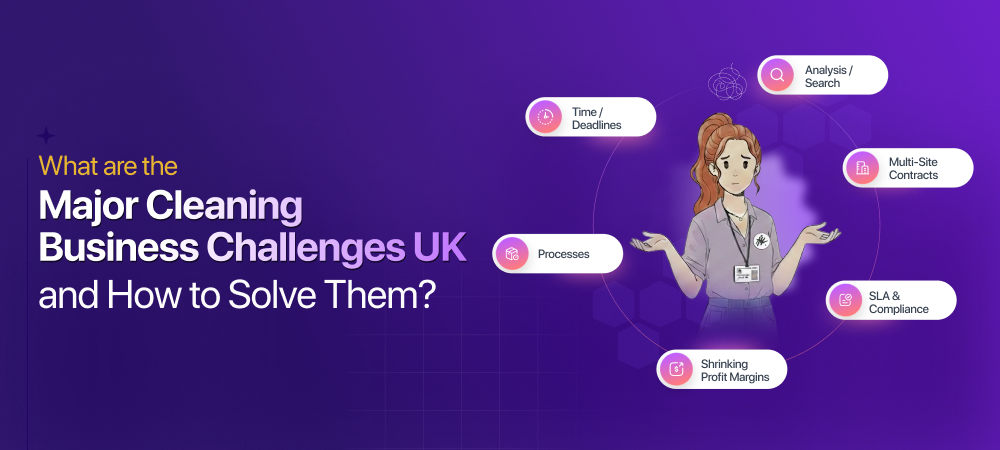
The owners of cleaning businesses face several challenges, starting from labor shortages and high turnover to increasing operational costs and client retention problems. These cleaning business challenges UK can slow down growth, affect service quality, and decrease profitability. Here are the various challenges:
🔶 Labour Shortages and High Staff Turnover
One of the biggest challenges across the cleaning industry is the ongoing labour shortage. Recruiting reliable cleaners, retaining them long-term, and ensuring consistent performance has become increasingly difficult. Many cleaners view the role as temporary, leading to high turnover, frequent onboarding, and gaps in service delivery.
When teams are understaffed, existing cleaners are overworked, morale drops, absenteeism increases, and service quality suffers, creating a ripple effect that directly impacts client satisfaction.
Solution:
Cleaning businesses are turning to structured workforce management to reduce dependency on manual coordination. Digital scheduling, clear task assignments, and mobile access to job details help cleaners feel more organised and supported. When staff know exactly what’s expected, where to go, and how their work is tracked, accountability improves, and attrition reduces.
🔶 Managing Multi-Site Contracts Effectively
As cleaning businesses grow, they often take on multi-site contracts like offices, retail chains, schools, healthcare facilities, or commercial buildings spread across locations. While this supports business growth, it also introduces operational complexity.
Managers struggle to maintain visibility across sites, ensure consistent service standards, and respond quickly to issues without physically being present everywhere. Small gaps in oversight can quickly lead to missed tasks, SLA breaches, or client complaints.
Solution:
A centralised management system gives businesses real-time visibility across all sites from one dashboard. Managers can monitor attendance, track task completion, and identify issues early, without constant site visits. This level of control makes scaling safer and more sustainable.
🔶 Increasing SLA Pressure and Compliance Requirements
Service Level Agreements (SLAs) have become stricter than ever. Clients now demand documented proof that cleaning tasks were completed on time, to standard, and as agreed. Manual reporting methods, paper checklists, spreadsheets, or WhatsApp updates are no longer sufficient.
Failing to meet SLA requirements can result in penalties, disputes, or even loss of contracts, especially in competitive commercial environments.
Solution:
Digital checklists, automated task tracking, and time-stamped proof of work help cleaning businesses stay SLA-compliant without extra admin. Automated reports provide clear evidence for audits, client reviews, and renewals, reducing disputes and building trust.
🔶 Rising Client Expectations for Transparency and Quality
Today’s clients expect more than clean spaces. They want transparency, communication, consistency, and measurable performance. Even a single missed visit or delayed response can damage long-term relationships.
Clients increasingly expect to get proof of task completion, faster issue resolution, regular performance reports, and clear communication channels. Without the right systems, meeting these expectations becomes overwhelming.
Solution:
Cleaning businesses are shifting toward real-time reporting and visibility. When service delivery data is automatically captured and easily shared, clients feel informed and confident. Transparency strengthens relationships and positions the cleaning provider as a professional, reliable partner rather than just a service vendor.
🔶 Operational Inefficiencies and Manual Processes
Many cleaning businesses still rely on manual processes, paper schedules, phone calls, spreadsheets, and fragmented communication. These methods are time-consuming, error-prone, and difficult to scale.
Manual operations often lead to missed or duplicated tasks, poor communication between managers and cleaners, delays in reporting and invoicing, and a lack of accountability.
Solution:
Automation and digital workflows streamline daily operations. From job allocation to task completion and reporting, automation reduces human error, saves time, and allows managers to focus on growth rather than firefighting daily issues.
🔶 Cost Pressures and Shrinking Profit Margins
Rising wages, increased supply costs, compliance requirements, and competitive pricing have significantly reduced profit margins in the cleaning industry. At the same time, clients expect higher service standards without corresponding increases in contract value.
These forces cleaning businesses to do more with less, a difficult balance without operational efficiency.
Solution:
Improving efficiency through better planning, reduced rework, and optimised staffing directly impacts profitability. When businesses gain better visibility into performance, attendance, and service delivery, they can control costs without compromising quality.
How Tapapp is the Best Choice for Addressing Today’s Cleaning Business Operation Problems?
Tapapp is developed to help the cleaning businesses in the UK to overcome operational complexity, improve visibility, and remain compliant in an increasingly demanding industry.
➡️ Built for Modern Cleaning Businesses Operations
Tappapp can be defined as a purpose-built cleaning business management software for solving everyday cleaning business operations problems. It centralizes task allocation, centralises scheduling, reporting, and attendance tracking, providing managers a clear, real-time view of operations without depending on manual processes or disconnected tools.
➡️ Supporting Teams Amid Labour Shortages
Labour shortages stay as a big challenge in the UK. Tapapp ensures that the cleaners get transparent instructions, structured schedules, and site-specific tasks, decreasing confusion, missed work, and dependency on constant supervision.
➡️ Centralized Control for Multi-site Contracts
Handling several locations becomes simpler with the single-app dashboard oversight provided by Tapapp. Managers are capable of monitoring attendance, performance, and completion of tasks across all sites, ensuring consistency in standards of service while scaling operations with confidence.
➡️ Simplifying SLA Compliance and Reporting
Tapapp decreases SLA risk via digital checklists, automated reports, and time-stamped tracking of tasks. This offers reliable proof of work, minimizes disputes with clients, and supports audits.
➡️ Meeting Rising Client Expectations with Transparency
Clients increasingly expect accountability and visibility. Tapapp allows transparent service delivery by offering correct, real-time data that builds trust and strengthens long-term relationship with the client.
➡️ Enhancing Efficiency and Protecting Margins
By eliminating operational inefficiencies and manual workflows, Tapapp helps businesses decrease costs, protect margins, and optimize resources, without compromising on the quality of service.
Conclusion
Handling a cleaning business at present is more complicated than even with multi-site contracts, labour shortages, strict SLAs, and the increasing expectations of the clients create major cleaning business challenges UK. Depending on manual processes just increases inefficiency, risk, and inconsistency. In order to overcome common cleaning business operations problems, businesses require better control, visibility, and real-time insights into their every-day operations. Purpose-built digital solutions are not an option anymore, they have become necessary for maintaining the quality of service or meeting the compliance needs, as well as for protecting margins.
By adopting premier and high-functional cleaning business management software, businesses can optimize operations, enhance accountability, and confidently navigate the current demanding industry landscape.
Frequently Asked Questions
Yes. Several modern cleaning management platforms provide offline functionality, enabling cleaners to finish tasks without the access of internet access and sync information automatically as the connectivity gets restored.
Absolutely. Clear schedule, visibility of tasks, and attendance tracking enhance accountability, decrease confusion, and help managers to find out the issues related to attendance early. This mostly leads to low absenteeism.
Most of the purpose-built platforms enable custom task lists, checklists, as well as reporting depending on contract needs, making it easy to handle varied client agreements.
Trustworthy software uses secure role-based access, cloud infrastructure, and data protection measures for keeping client, business, and staff information compliant and safe.
In case you are facing SLA risks, missed tasks, limited visibility, manual reporting, or difficulties in handling multiple sites, your business is ready for managing software.
UK companies need to look for software supporting multi-site operations, SLA reporting, compliance requirements, ease of use for cleaners, and scalability as the business grows.
Software centralises service information, task completion records, and attendance, decreasing disputes, enhancing billing accuracy, and speeding up client reporting and invoicing processes.
Key features involve attendance tracking, workforce scheduling, digital checklists, SLA reporting, real-time dashboards, multi-site visibility, and secure cloud-based access.