
Key Takeaways:
- Grounds maintenance businesses mostly deliver high-quality work. However, without structured documentation and verifiable reporting, clients perceive risk and unreliability.
- WhatsApp photos, paper job sheets, and Excel summaries limit transparency, enhance errors, and weaken credibility during disputes, audits, and renewal discussions.
- Without proper automated SLA reporting for grounds maintenance, missed visits and compliance failures often go unnoticed until complaints, penalties, or contact reviews arise.
- In 2026, managing agents, councils, and housing associations assess real-time workforce audit trails, visibility, and GDPR compliance during tender evaluations.
- Structured digital systems decrease disputes, strengthen contract compliance, enhance renewal positioning, and shift conversions from defensive explanation to data-backed confidence.
Introduction: Contracts Are Won on Promise and Lost on Proof
A grounds maintenance business hardly loses contracts because of badly cut grass or hedges not shaped properly. Most contractors deliver powerful operational work. The issue generally remains where the visibility is less, and that is in reporting.
Contacts are won at the tender stage with the promises: defined service levels, response times, visit frequencies, safety standards, professional oversight, and environmental compliance. However, retaining or losing contracts depends on the proof.
Clients want evidence of:
- When the work was done
- Who attended the site?
- What tasks were completed
- If the SLAs were met
- How the issues were handled.
In the UK, mainly with the managing agents, councils, housing associations, and commercial estates, documentation means credibility. Without any structured system, even the most trustworthy contractors can seem reactive or disorganised.
In 2026, performance without any proof is often treated as non-performance. Without any right grounds maintenance management software in the UK, businesses end up losing contracts that they technically fulfilled.
The Reporting Gap in UK Grounds Maintenance Businesses
The reporting Gap is the disconnect that exists between the work on the site and the information that reaches the client’s desk. While the teams of the ground maintenance businesses are battling the elements to keep the sites maintained, your clients are mostly operating in an information vacuum.
🔶 The Legacy Method
Several Firms in the UK depend on fragmented manual processes:
- Paper Job Sheets: These are mostly illegible, prone to being lost in a van, and provide no real-time verification.
- WhatsApp Groups: While fast, they develop a “black hole” of data where the photos have no timestamps and are almost impossible to retrieve during a dispute after months.
- Manual Excel Entry: This needs hours of administrative “double-handling”, where the information is transcribed from the paper to the screen, inviting human errors.
🔶 The Operational Visibility Gap
This kind of dependency on annual tools develops what we call the operational visibility gap. Without having grounds maintenance reporting software in the UK, the business owners will not be able to see the field operations in real-time, and the client will also not be able to verify if their money is being spent effectively. This lack of transparency is the main driver of contact churn in 2026.
The 7 Reporting Failures That Cost Businesses Contracts
The reporting failures that cost business contracts without ground maintenance businesses having grounds maintenance reporting software in the UK are as follows:
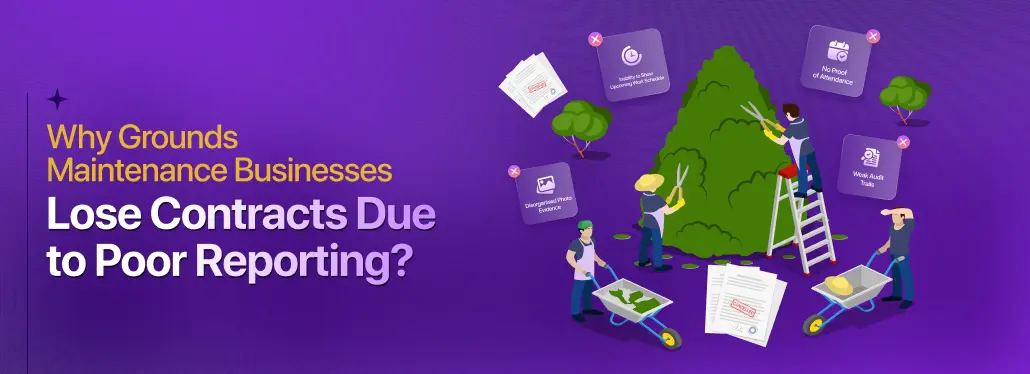
➡️ No Proof of Attendance
One of the most common questions from the frustrated property managers is “Were they even here?” If the only proof of attendance you have is a manual timesheet or a fuel receipt, you are surely in trouble. Clients are bound to feel ignored. In the era of GPS-based real-time tracking, the lack of location-stamped attendance feels similar to lack of accountability.
➡️ Inability to Show Upcoming Work Schedule
Clients hate surprises, mainly the noisy ones. If you cannot offer the clients a shareable, live view of the next schedule, you are disrupting the operations of the client. So, whether it is a school that needs quiet for conducting exams or a corporate office that is hosting an event, not providing a clear schedule makes you a liability and not a partner.
➡️ No Visibility into What Workers Are Actually Doing
Service Level Agreements (SLAs) are the heartbeat of commercial contracts. If your contract says, “Grass must not exceed 50mm,” but you have no historical record of height measurements or frequency, you are in breach the moment a client complains. Poor tracking turns minor oversights into legal disputes.
➡️ Weak Audit Trails
When a slip-and-fall accident occurs on a leaf-covered path or a frost-damaged walkway, the “Paper Trail” is your only shield. Businesses losing contracts often have “gappy” records. If you can’t produce a report showing that the path was cleared at 08:00 AM on Tuesday, you (and your client) are exposed to massive liability.
➡️ Disorganised Photo Evidence
A WhatsApp group full of blurry photos is not a reporting system. If your office staff has to spend hours hunting through a gallery to find a “Before” photo from three weeks ago, your reporting is failing. Disorganised evidence is as useless as no evidence at all when a dispute arises.
➡️ No Centralised Performance Reporting
If a client asks, “How has our site improved over the last six months?” and you have to spend three days “crunching numbers” in a spreadsheet, you’ve lost. Modern clients expect monthly performance dashboards that show trends, completion rates, and reactive vs. planned maintenance ratios.
What Clients Actually Expect in 2026?
In the year 2026, with the rapidly evolving UK market, the “standard” for ground maintenance has transformed from physical labour to digital transparency. At present, high-value clients, mainly those in the public sector, now involve “reporting capabilities” as one of the main sections in their tenders.
- Transparency as a Service: Clients expect to see the information that you see. They expect a portal or a report that reflects the progress in real-time.
- GDPR & Data Security: With the increase in digital logging, clients want their site data to be handled by a secure, GDPR-compliant platform and not personal phones.
- Accountability over Assumptions: In a budget-conscious environment, handling agents should prove to their own stakeholders that each pound spent on the work is accounted for.
What Proper Grounds Maintenance Reporting Software in the UK Should Provide?
An efficient and reliable grounds maintenance reporting software in the UK should offer the following:
🔷 GPS-Based Attendance Logs
Correctly record the site arrival and departure by using GPS verification, ensuring an indisputable attendance proof while decreasing disputes, invoice rejections, and SLA penalties from clients.
🔷 Site-Level Clock-In Verification
Allow workers to clock in only when present physically at the correct site location, preventing false check-ins as well as strengthening grounds maintenance contract compliance standards.
🔷 Live Job Status Tracking
Offer real-time visibility into active, pending, and completed tasks, enabling supervisors to monitor productivity immediately and resolve issues before clients can escalate concerns.
🔷 Digital Job Sheets UK
Replace paper-based documentation with structured digital job sheets that are capable of capturing notes, tasks, signatures, and compliance checks in a single, organised, and accessible system.
🔷 Timestamped Photo Uploads
Attaching automatically time-stamped and site-tagged photos to each job record, developing credible and retrievable visual proof of completed work for dispute resolution.
🔷 Supervisor Dashboard
Provide a centralised dashboard displaying workforce activity, site performance, attendance records, and SLA metrics, empowering managers with data-driven operational oversight.
🔷 SLA Tracking Alerts
Monitor contact requirements automatically as well as trigger alerts for incomplete tasks or missed visits, ensuring proactive SLA reporting for grounds maintenance.
🔷 Exportable Audit-Ready Reports
Generate downloadable, structured reports with attendance logs, performance data, and task histories, simplifying grounds maintenance audit reporting processes.
🔷 Client-Facing Reporting Summaries
Develop professional performance summaries showcasing accuracy in attendance, SLA compliance rates, and completion statistics for strengthening renewal discussions and client confidence.
How Structured Reporting with a Grounds Maintenance Reporting Software in the UK Changes Contract Conversations?
| Scenario | Without Software | With Tapapp |
| Client Dispute | “I am sure they were there, let me call the lead.” | “Here is the GPS log along with timestamped photo from 10:00AM” |
| Audit Request | “Give us 48 hours for finding the files.” | “I will email you the complete audit log right now” |
| Renewal | “Defending your price depending on “good service” | Offering your value with 99% SLA compliance data. |
How Tapapp Helps Grounds Maintenance Businesses Close the Reporting Gap?
To survive in the modern grounds maintenance sector, businesses should move beyond “checking in” and start “offering value”. Tapapp acts as the core nervous system of the operations, replacing scattered paper trails with a single, unified source of truth. By digitising the workflow from the field to the office. Tapapp, the reliable grounds maintenance reporting software in the UK makes sure that all action taken by your team is tracked, verified, and ready for review by the client.
1️⃣ GPS Attendance & Workforce Visibility
Tapapp offers a live, map-based view of the complete workforce utilising GPS technology. This enables supervisors to verify exactly when a team arrives at the boundary site and how long they stayed, offering an indisputable digital trail that helps in protecting your business from false claims of non-attendance.
2️⃣ Digital Job Sheets
Transitioning to the digital job sheets of Tapapp ensures that all the tasks, starting from hedge trimming to chemical application is logged with mandatory fields. This helps in preventing crews from skipping crucial steps while enabling the office to monitor progress in real-time without making a single phone call or chasing paper.
3️⃣ SLA Reporting
Tapapp helps in automating the process of evidence-gathering by compiling attendance and task completion logs into audit-ready, professional reports. This kind of proactive approach enables you to present the client with automated performance proof, converting potential friction into a robust tool for contract retention and successful tender bids.
4️⃣ Compliance & Data Management
Tapapp offers a secure, encrypted environment for all the site-level information, involving incident reports and risk assessments. By centralising this information, you make sure your business stays compliant with GDPR guidelines and ready for audit, enabling you to produce critical safety documentation immediately whenever an inspector or client makes a request.
Warning Signs Your Reporting System Is Costing You Contracts
Most of the grounds maintenance businesses do not realise their reporting system is a liability until a contract comes under review or is already lost. The danger is not a dramatic failure. It is a slow erosion of credibility. Given below are the clearest warning signs that your existing reporting setup may be putting the renewal, revenue, and reputation at risk.
➡️ You Rely on Excel to Create Client Reports
If monthly or quarterly reports are manually compiled in spreadsheets, you are working reactively. This generally means:
- Data is pulled from several sources.
- Attendance logs are entered manually.
- Photos are separately stored.
- SLA performance is calculated manually.
Manual reporting enhances the risk of omissions, errors, and inconsistencies. It also consumes crucial management hours.
In competitive tenders, manual Excel summaries do not compare to system-generated, structured reports of performance.
➡️ You Cannot Instantly Prove Attendance
If a client questions whether your team has attended the site, can you provide them with GPS-verified evidence within minutes?
Or do you require to:
- Call the supervisor
- Check paper sheets
- Contact the operative
- Search WhatsApp messages
Any delays weaken confidence.
Modern grounds maintenance contract compliance depends on instant proof and not reconstructed explanations. If proof needs investigation, your system is fragile.
➡️ You Scramble During Audits
Audits should feel procedural and not stressful. In case you are preparing for a council or a housing association audit involves:
- Gathering paperwork from several folders
- Searching emails for incident reports
- Matching photos to dates manually
- Rebuilding the history logs of visits
Your reporting structure lacks integrity.
Robust grounds maintenance audit reporting systems enable immediate export of visit history, SLA performance, and safety documentation.
If audits create anxiety, your reporting is reactive.
➡️ You Have Experienced Invoice Disputes
Invoice disputes are mostly a symptom of weak documentation.
Common scenarios include:
- Questions about incomplete tasks
- Client disputes missed visits
- Disagreements about the frequency of service
- Requests for proof months later
If the documentation cannot be quickly retrieved, payment details follow.
Even one or more recurring disputes per quarter can damage trust in the long-term.
➡️ SLA Performance Is Not Tracked Automatically
In case you only discover missed visits when a client raises it, your SLA reporting for maintenance is reactive.
Warning indicators involve:
- No automated monitoring of visit frequency
- No real-time SLA percentage dashboard
- No alert system for the tasks missed
- No structured performance scoring
SLA failures must be flagged before the clients notice them.
If they are discovered in review meetings, your reporting system is exposing you to preventable risks.
➡️ You Depend on WhatsApp Photos for Proof
WhatsApp is not a system for reporting. Photos sent through messaging apps:
- Are not achieved centrally
- Mostly lacks timestamp validation
- May not include identification of the site
- Are difficult to retrieve months later
If photo evidence is stored across personal devices or chats, there is no structured proof of service.
In disputes, informal photo storage weakens the position of the business largely.
➡️ Supervisors Call Workers Daily for Updates
If supervisors should constantly call operatives to ask:
- “Have you finished Site A?”
- “Did you attend Block C?”
- “Can you send me a photo?”
This indicates a lack of grounds maintenance reporting software in the UK. Having a phone-based monitoring system is time-consuming, unreliable, and inefficient.
Real-time visibility should be accessible via dashboards and not depend on everyday calls.
➡️ You Cannot Show Performance Trends Over-time
When it comes to contract renewal, can you present:
- 12-month accuracy of attendance
- SLA compliance trends
- Incident response enhancement rates
- Productivity data perspective
Or do you depend on verbal reassurance?
If you cannot demonstrate measurable operational excellence, renewal discussions become pricing-focused rather than performance-focused.
Data strengthens negotiation leverage.
➡️ Reporting Seems to be “Admin” Instead of Strategy
If reporting is internalised as paperwork rather than performance evidence, it is a red flag.
Reporting should:
- Support compliance
- Protect revenue
- Strengthen renewal positioning
- Enhance operational efficiency
- Decrease the management oversight burden
In case your reporting process adds up to stress rather than control, it is affecting growth.
➡️ You Have Lost a Contract and “Do not Fully Know Why”
This is the crucial warning sign. When the feedback involves phrases such as:
- “We are looking for improved transparency.”
- “We require enhanced reporting visibility.”
- “Another contractor provided robust reporting systems.”
The issue is rarely the quality of service alone. It is mostly structured proof.
Conclusion
In the present competitive landscape, operational excellence alone is not enough for retaining contracts. Ground maintenance businesses should demonstrate performance with structured and clear evidence. Clients expect transparency, accountability, and real-time visibility, not assumptions or reconstructions. This is why investing in trustworthy grounds maintenance reporting software in the UK is not optional anymore; it is strategic. The right system helps in protecting revenue, decreases disputes, strengthens compliance, and enhances renewal success rates. In the year 2026 and beyond, contractors who can immediately prove attendance, service quality, and SLA compliance will not only retain contracts but will also help win more of them.
Frequently Asked Questions
In the case of slip-and-fall incidents or property damage, documented proof of contractor site visits and risk mitigation is crucial. Without timestamped records and task logs, insurers can challenge claims, enhancing financial exposure for contractors.
Yes. When operatives know that task completion, attendance, and time on-site are logged digitally, productivity enhances. It decreases time theft and inconsistent service delivery across several locations.
Grounds maintenance reporting software logs waste disposal, chemical usage, safety checks, and environmental actions with timestamps and site tags, developing auditable records supporting regulatory inspections and strengthening sustainability credentials during tenders.
Structured reporting helps in automating attendance logs, performance summaries, SLA tracking, decreasing spreadsheet consolidation, repetitive follow-ups, and manual entry, enabling businesses to cut administrative workload and allocate staff to high-value activities.
Real-time field reporting offers immediate proof of attendance, SLA status, task completion, developing transparency, decreasing disputes, strengthening trust, and shifting client conversations from defensive explanations to evidence-based, confident discussions.
Most of the modern mobile reporting systems are intuitive and decrease paperwork, making adoption easy for the field teams, mainly when supported by structured onboarding, clear operational guidelines, and short training sessions.
Reporting data helps in supporting route optimisation, pricing refinement, workforce planning, performance benchmarking, and renewal negotiations, changing operational records into strategic insights that drive profitability, competitive advantage, and scalability.