
Key Takeaways:
- The landscaping and grounds maintenance industry no longer relies on traditional methods to calculate worker timings and attendance.
- Using multiple applications and tools for landscaping jobs can confuse both management and crew members.
- Spreadsheets, whiteboards, phone calls, and paper forms are slow and can cause data loss in most cases.
- A unified solution is the way to go when it comes to satisfying clients, manage field crew, and ease the job of management altogether.
Understanding the Importance of Grounds Maintenance Scheduling Software
The landscaping and grounds maintenance industry has evolved, with grounds maintenance management software reaching new heights and offering innovative solutions. As operational complexity is slowly increasing, manual management systems cannot keep up or handle things effectively.
Modern ground maintenance businesses are often seen juggling between multiple job sites, coordinating diverse field crews, managing varying client expectations, and navigating unpredictable external factors such as weather disruptions and equipment failures.
This is why it is crucial to understand the importance of ground maintenance scheduling software and recognize how traditional methods can fail under pressure. Old technology, such as spreadsheets, whiteboards, phone calls, or paper forms, can often create a vague operational visibility, which leaves the management with more problems than solutions.
So how do you tackle the challenges? This blog will answer that question, so you can safely opt for ground maintenance reporting software without any worries.
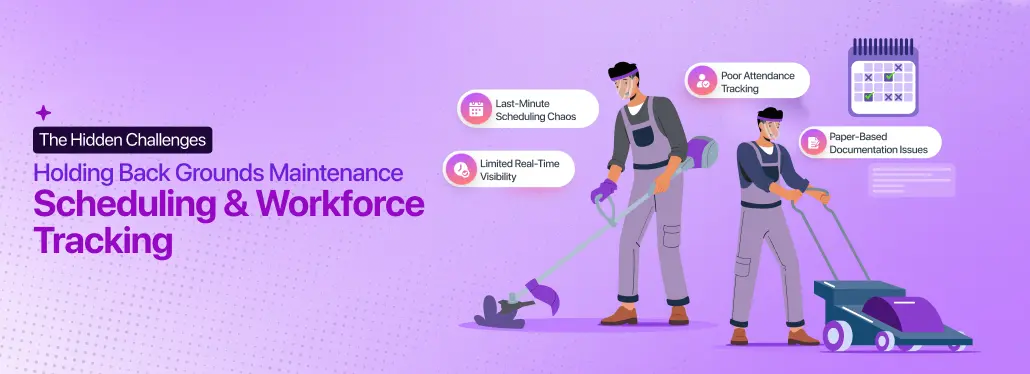
Challenges Hindering Proper Grounds Maintenance Scheduling & Workforce Tracking
Tackling issues related to grounds maintenance scheduling is already a barrier; on top of that, tracking your workforce adds to the pressure. With the rising challenges, ground maintenance scheduling software offers plenty of solutions to one. Let’s go through them one-by-one:
🔷 Challenge 1: Last Minute Scheduling Brings Operational Chaos
Hindrances like weather disruptions, equipment failure, client cancellations, and staff emergencies can create constant scheduling conflicts in grounds maintenance operations. A sudden rainstorm can hinder mowing jobs, and occurrences like an unexpected client request may require you to immediately redeploy your crew to a priority site.
With traditional methods, one would typically use whiteboards, spreadsheets, or even paper calendars. However, these methods cannot accommodate any rapid changes, at least effectively. Managers often waste valuable time making phone calls to notify dispersed field teams about revised schedules, which reach workers late.
▶️ Solution: Ground Maintenance Scheduling Software
Modern cloud-based platforms offer instant schedule synchronization across all devices. When a manager attempts to adjust assignments, the field workers will receive an automated notification through the app, which ensures every worker is operating from an identical information.
Real-time updates reduce communication delays and scheduling conflicts by a significant margin. Automated client notifications always keep the customer informed about changes, which helps maintain transparency and trust even during times of disruptions
🔷 Challenge 2: Limited Visibility Brings Less Control
Once a crew leaves the office, most managers essentially operate blindly without real-time tracking capabilities. There’s no reliable way to verify current team locations, confirm service completion, or assess job progress throughout the day.
This type of visibility gap often creates large operational challenges. Managers fail to confidently answer client questions as they are often out of the loop themselves. Be it a service status question or an estimated arrival time follow-up, they stay blind. Dispatching the nearest available crew to urgent jobs becomes guesswork instead of data-driven decision-making.
▶️ Solution: Workforce Tracking
This issue can be solved through GPS-based check-in and check-out systems from a grounds maintenance reporting software. Through this, systems offer live location data for all field personnel. Managers get access to comprehensive visibility into crew movements across the service territories throughout the workday.
Ground maintenance reporting software has the capability to capture detailed, time-stamped records that show a team’s exact time when they arrive on the property and for how long they remain on the site. The GPS verification system offers undeniable proof of service delivery, which safeguards a business against billing and compliance issues and also eases the process.
🔷 Challenge 3: Poor Attendance Tracking
If an organization lacks dedicated software for tracking employee attendance, it becomes extremely tedious to maintain manual records of clock-ins and clock-outs, which is error-prone and undermines the authority. Managers often struggle to verify crew member’s start and stop times during their workdays, especially when teams are dispersed across various job sites throughout the service territory.
Traditional attendance methods such as paper timesheets and phone-based check-ins are mostly self-supporting, which can open doors to inaccuracies. A worker may forget to log their times, do round numbering arbitrarily, or use tricks like buddy-punches for absent colleagues. This leaves managers will very few reliable ways.
▶️ Solution: Automated Attendance Management
Grounds maintenance scheduling software, such as Tapapp, can transform attendance tracking with the help of automated GPS-verified check-in and check-out systems. When a worker arrives at the job site, he or she can simply use their handheld device to clock-in, which automatically captures the timestamp and location coordinates.
The GPS verification system can ensure the real-time visibility of the employee at the assigned properties when they record their time. This eliminates fraudulent possibilities regarding clock-ins from remote locations. The system has the capability of maintaining a complete audit trail of attendance records along with timestamp and location data for managers.
🔷 Challenge 4: Paper Documents Lead to Data Quality Issues
Field crews who work across multiple properties generate substantial paperwork regularly. Things like service checklists, site condition reports, equipment usage logs, safety inspections, and client signoffs require documentation for billing, compliance, and quality assurance.
Paper forms can face harsh field conditions through rain damage, accidental loss, spills, and illegible handwriting, which could potentially compromise data integrity. Rushed workers often skip sections or offer incomplete information under time pressure. This can reduce the documentation value and lead to poor information relay.
▶️ Solution: Digital Forms
Ground maintenance reporting software eliminates paper through digital forms through mobile apps. Workers complete a structured checklist on smartphones or tablets, which ensures that all required fields are captured prior to submission.
Photo documentation capabilities also allow crew members to capture visual evidence of site conditions, finished work, and any issues discovered during the process. Images are attached to the work orders along with timestamps and GPS coordinates, building comprehensive service records.
🔷 Challenge 5: Inefficient Job Scheduling Wastes Resources
Grounds maintenance companies should coordinate with multiple crews across diverse properties with different service requirements. Each crew possesses unique skill levels, equipment availability, and capacity constraints that can affect assignment sustainability.
Manual scheduling struggles to optimize multiple variables simultaneously. Planners often default to familiar patterns instead of analyzing optimal assessment. This results in suboptimal resource utilization.
▶️ Solution: Intelligent Scheduling Optimization
Advanced ground maintenance scheduling software makes use of algorithms to create optimal crew assignments automatically. This system considers various factors at the same time, such as crew locations, skill requirements, equipment needs, customer preferences, and current workload. Smart routing minimizes total travel distance for all crews. It reduces fuel costs and maximizes billable hours.
The software itself can calculate job durations realistically, all based on historical performance data and avoiding guesswork. The drag-and-drop interfaces allow for easy scheduling adjustments while the system automatically checks for conflicts and availability issues.
🔷 Challenge 6: Delayed Problem Detection
Many ground maintenance companies discover operational problems only after they become a serious threat. Issues related to service quality, equipment failures, safety lapses, and workforce productivity remain invisible until customers complain or costs are incurred.
This reactive approach leaves managers constantly busy with miscellaneous items rather than preventing actual problems. By the time issues surface, they have already caused enough damage to client relationships, profitability, and team morale. This is why detecting problems becomes a pivotal point in these businesses, as they have a high chance of causing operational disruptions.
▶️ Solution: Proactive Monitoring and Early Warnings
Good grounds maintenance reporting software offers real-time operational dashboards that show performance metrics across multiple dimensions. With its help, managers can monitor service completion metrics, average time spent on property, and client satisfaction scores on a regular basis. It makes managing and controlling the crew easy and streamlined.
Features like automated alerts notify supervisors immediately when predefined thresholds are exceeded or not met. Moreover, performance analytics identify trends before they turn into a business crisis. Quality control features also ensure standards are met during work through photo documentation and checklist completion before jobs are closed.
🔷 Challenge 7: Manual Reporting Consumes Administrative Time
Grounds maintenance businesses demand comprehensive reporting for stakeholders. Client contract reports are proof of service delivery, and financial reports are there to track profitability per property. Operational reports measure crew productivity, and compliance reports are also needed to satisfy regulatory requirements.
When your data exists across various paper forms, spreadsheets, different software systems, and individual email threads, compiling reports can get time-consuming and confusing. Administrative staff are often seen spending hours and days gathering information, verifying accuracy, and formatting presentations.
▶️ Solution: Automated Reporting
Integrated grounds maintenance reporting software has the capability to automatically compile data from all operational activities into centralized dashboards. It can schedule information, track records, digital forms, and financial data, and feed it into a unified reporting system. Managers can create comprehensive reports easily, and with a few clicks, with the help of standard templates.
The customizable report builder allows for easy creation of specialized views, focused on metrics and time periods. One can filter and drill-down capabilities, which allow for a detailed investigation when unusual patterns appear. Visual dashboards showcase key indicators with the help of charts and graphs, which help communicate complex information at a glance.
🔷 Challenge 8: Communication Fragmentation Between Office and Field
Ground maintenance operations typically separate the office staff from field crews working across dispersed locations. Office staff must rely on phone calls, text messages, and emails to bridge this gap, which creates communication fragmentation where critical information is lost in the gaps.
Field workers often lack the visibility for schedule changes, special client instructions, or priority updates that happen at the office levels. At the same time, managers also struggle to get timely status updates on job progress, completion, or issues encountered.
▶️ Solution: Centralized Communication Platform
All-in-one grounds maintenance scheduling software delivers unified communication channels that are accessible to both office and field personnel. Everyone works from the same platform instead of juggling through various applications, which raises complexities and slows down operations.
Workers receive complete job details, site-specific notes, and special instructions directly from their mobile app. Schedule changes, updates, and urgent messages will appear as instant notifications that cannot be missed by one, hence the operational swiftness will not be disturbed.
🔷 Challenge 9: Scaling Operations Without Infrastructure Overwhelms
Successful grounds maintenance companies face growth opportunities through new contracts, expanded service territories, and larger client accounts. However, manual operational processes that work for smaller teams become unworkable on a larger scale. Scheduling complexities increase significantly with additional crew members, property, and clients added.
Traditional methods may prove viable in a five-person team, but when 50 members are in the equation, it becomes equally daunting. For a manager, it is a nightmare to juggle between dozens of crew members across hundreds of properties. As coordination demand grows, administrative overhead consumption also increases significantly.
▶️ Solution: Scalable Software Infrastructure
Cloud-based grounds maintenance scheduling software can handle complex operational issues without hampering performance. Be it 10 workers or 100, the platform can flawlessly handle it all, even when the business is scaling with its technical capabilities. With the help of an automated scheduling algorithm, the app can maintain optimization regardless of the operation size.
The standardized processes embedded into the software ensure consistent service quality across expanded operations. New employees follow the digital workflows as they are veterans. This reduces training time while maintaining standards at the same time.
Parting Thought
Ground maintenance reporting software solves most of the hidden challenges that create operational inconvenience for the company. These issues are often seen as directly threatening profitability, service quality, and competitive positioning of an organization. Things like manual systems, paper documentation, and fragmented communication cannot hold the demands of modern grounds maintenance businesses.
Hence, implementing ground maintenance scheduling software becomes a crucial step for the business. It is not just about adopting new technology in the market, but it is about solving fundamental operational setbacks that can limit your growth potential, permanently, if not addressed early. Real-time visibility, automated workflows, and centralized data management can help managers reach new heights.
Tapapp addresses such critical challenges with finesse, with a unified scheduling system, GPS-based workforce tracking, digital forms, and automated reporting on a single accessible platform. The competitive landscape is increasingly favoring organizations that can leverage technology to deliver superior service levels and maintain operational efficiency without breaking their banks.
Frequently Asked Questions
Absolutely, modern grounds maintenance scheduling software like Tapapp has the capability to work offline. Field workers can complete digital forms, capture photos, and record their job information even without cellular coverage. Every piece of data is automatically synchronized with the system once the connection is restored. This leads to zero documentation gaps regardless of the site location.
GPS-based verification stops fake clock-ins just by confirming worker locations during check-in and check-out. The system can record the exact GPS coordinates with timestamps, ensuring crews are at assigned job sites rather than clocking in remotely. The location tracking feature creates proof of service delivery to clients and prevents fake clock-ins.
Cloud-based workforce management platforms use enterprise-grade security measures to protect operational data. The information from the application is encrypted during transmission and storage with the help of secure authentication protocols controlling access. Regular backups also help with data loss prevention, while permission-based access ensures personnel are only authorized.
Grounds maintenance scheduling software can help manage seasonal fluctuations with the help of flexible planning capacity based on historical data analysis. The system can track seasonal patterns across previous years and enable accurate forecasting for peak periods. Automated scheduling can accommodate additional crew members during busy seasons, and workload balancing stops overcommitment.
Technology transforms landscaping services by allowing real-time communication, GPS tracking, and data-driven decision-making. Digital forms ensure consistent service quality through standardized checklists and photo documentation. Automated scheduling can optimize assignments for crew and routes too, as well as reduce costs and improve response times. Technology plays a massive role in improving such services.