
Key Takeaways:
- Paper job sheets delay updates and create communication gaps, which makes it tough for managers to track progress and make informed decisions in real-time.
- Manual paperwork increases workload, and teams end up spending hours collecting, sorting, and re-entering data, slowing down operations.
- Switching to digital systems centralise job data and automate workflows to help service companies run operations more efficiently at scale.
What Are Paper-Based Job Sheets?
Paper-based job sheets are the traditional forms of service that the teams utilise to record what’s happening on the site, time spent, maintain attendance, and more.
It’s 2026 and it may still be hard to imagine that many businesses are still struggling using paper-based job sheets. A survey reflected that nearly 45% of SMBs depend on paper records and only 18% have chosen the paperless path.
These job sheets are filled out by hand and are still widely used across the UK in cleaning, facilities management, grounds maintenance, etc. On the surface of it, it does feel simple. No login, no app, and that explains why many businesses still continue to use them.
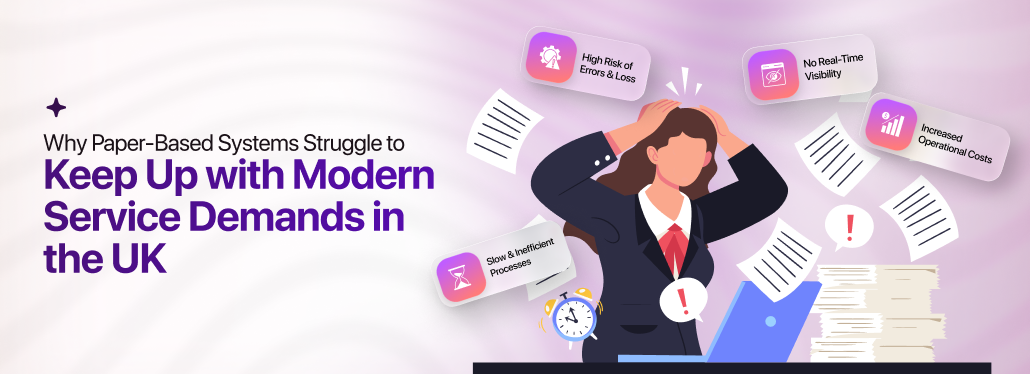
However, in practice, these sheets don’t stay reliable for a long time. Once the job is done, they need to be reviewed and manually processed into the system for reporting and invoicing. Especially when you are managing multiple schedules, sites, and teams, this process slowly eats up the system, ending up overwhelming you.
What starts as an easy way to maintain records soon turns into a system that limits visibility and crops up unnecessary issues.
The Real Problems with Paper Job Sheets
Most service businesses start small, a job sheet here, a timesheet there, and before you know, your entire process is operating on systems that were never built to scale.
The paper isn’t the issue, it’s what it can’t do.
🔷 Problem 1: Delayed and Unreliable Job Records
With paper job sheets, records are not immediately captured just after the completion of work. Engineers need to fill out the job sheets after leaving the site instead of relying on real-time inputs. This could result in missing details or inaccurate timelines. For businesses handling multiple teams across the site, delays can make it tough to make progress.
Digital Software Solution:
- Engineers capture job details in real-time at the site itself
- Structured digital forms ensure complete data entry
- Automatic timestamps record when each update was made
- Live data synchronisation
- Accurate records reduce manual follow-ups
🔷 Problem 2: Lost or Damaged Job Sheets
In service and maintenance operations, paper job sheets can be easily misplaced, lost, or damaged before they reach the office. This can result in incomplete records and gaps in reporting, causing the managers to chase paperwork to ensure that the work was captured. Moreover, lost records make it difficult to verify the service delivery or resolve client queries.
Digital Software Solution:
- Job-related data is all stored digitally, eliminating the risk of damage or loss
- Job records are saved immediately
- Cloud-based access ensures that the information is always available
- Reliable data improves reporting accuracy
- Easy access to records helps resolve client queries
🔷 Problem 3: Paper Forms Create Extra Admin Work
Paper-based job sheets are manually collected, sorted, and processed at the completion of every shift. After which, office teams spend hours re-entering data into systems for invoicing and reporting. Manual entry can lead to inaccurate data entry, slowing down decision-making. Eventually, the admin workload increases as the number of teams and jobs increases.
Digital Software Solution:
- Job data is captured and is automatically available across the system
- Automated workflows reduce repetitive admin tasks
- Reports are generated instantly from completed job data
- Centralised data eliminates inconsistencies
🔷 Problem 4: Compliance & Audit Difficulty
Missing signatures, data, or incomplete forms create compliance issues, and it is tough to organise and retrieve them during audits. Due to inconsistent documentation, it’s hard to prove whether work was completed on-time and accurately. These gaps, over time, create compliance risks.
Digital Software Solution:
- Mandatory fields ensure all required data is recorded before submission
- Timestamps, digital signatures, and photos provide proof of service
- All records are stored securely and organised
- Complete audit trails are automatically maintained for every job
- Consistent documentation supports compliance with industry standards
- Access to records simplifies inspections and reduces risks
🔷 Problem 5: Paper Systems Do Not Work for Multi-Site Service Companies
It’s natural that if you are managing multiple sites without a digital system, you are bound to end up with scattered and disconnected paperwork. There’s no centralised visibility across locations and ongoing activities. Managers depend on calls and texts to track progress. Additionally, coordinating schedules and the status of work becomes difficult. Such a process leads to more confusing operations.
Digital Software Solution:
- Centralised platform provides real-time visibility across all teams and sites
- Scheduling and tracking are managed in one system
- Field and office teams stay connected
- Scalable system supports business growth without added complexity
🔷 Problem 6: Paper Reports Look Unprofessional to Clients
Handwritten reports can appear unclear and unprofessional. This could also lead to missing details, reducing client confidence. Paper documents also cause delayed reporting, which directly impacts transparency and client communication.
Digital Software Solution:
- Clean and structured digital reports ensure consistency
- Branded reports appear more presentable to clients
- Reports can be generated instantly after job completion
- Faster and clearer report enhances the client experience
Paper Job Sheets vs Digital Job Management Software
In a time where accuracy, compliance, and speed are critical factors to business success, the debate between job sheets and digital job management software is more relevant than ever. Manual tracking may still exist in several organisations across the UK, but they are being rapidly outdated and replaced with digital software platforms.
| Aspects | Paper Job Sheets | Digital Job Management Software |
| Data entry | Manual, prone to error, time taking | Automated, accurate, fast |
| Accessibility | Physical copies only | Accessible anytime, anywhere |
| Real-time updates | No | Yes |
| Risk of data loss | High | Secure cloud storage |
| Collaboration | Slow | Seamless |
| Compliance & audits | Hard to track | Easily retrieval with organised digital logs |
| Reporting & insights | Manual | Instant |
| Scalability | Tough to manage as business grows | Easily scales with operations |
| Client experience | Lack of transparency | Faster service with better communication |
| Offline capability | Works offline but lacks syncs | Works offline and automatically syncs later |
What Switching to Digital Job Sheets Really Looks Like for UK Service Companies
Switching to digital job sheets for most UK service businesses usually starts with fixing the daily issues.
1️⃣ It Starts with One Problem
Most companies opt for digital transformation because paper stops working for them, resulting in delayed updates and missed job details. This doesn’t happen at once, but it’s a gradual shift.
Digitising the system means jobs get recorded accurately and in real-time, evidence is captured on site, and records reach the office on-time.
It’s a shift and not a transformation for the issue that’s been causing the most damage.
2️⃣ Your Engineers Stop Carrying Paper
Instead of collecting job sheets at the beginning of the day, engineers receive job updates directly on the app. They can:
- View the job details easily
- Capture signatures, photos, and notes on-site
- Update job status without delay
3️⃣ The Office Finally Gets Real-Time Visibility
No need to call technicians for updates because managers can:
- Track job progress in real-time
- See who is available
- Reassign work quickly
This creates a unified system instead of a scattered one.
4️⃣ Admin Work Reduces
This is one of the biggest changes because the back-office teams do not have to re-enter data from paper sheets. With digital:
- Work reports are auto-generated
- Data is structured
- Invoices can be created faster
5️⃣ Scheduling Becomes Faster
Instead of juggling spreadsheets, jobs are scheduled digitally. This means:
- Fewer delays and missed jobs
- Better allocation based on location and skills
6️⃣ Compliance and Audit Become Effortless
Audits become painful with paper, but digital makes them effortless.
Now you have:
- Photo proof of work
- Digital signature
- Time-stamped job records
- Complete audit trails
7️⃣ The Real Shit in Control
It’s not about going paperless but about:
- Knowing what’s happening
- Reducing back-and-forth
- Knowing who’s on site and at what time
- Running more jobs without increasing headcount
And this is the reason why digital job sheets quickly became the operational backbone for service businesses.
Essential Features UK Service Companies Need Instead of Paper Job Sheets
Now you know how moving away from paper starts to reshape the way your day actually runs, from how jobs are handled to how information flows across your team. Here are the features UK service companies start relying on once that shift happens:
🔶 Job Scheduling
No more mornings starting with papers or long briefings when the job alerts are already being sent directly to the engineer’s phone. This ensures no relays, no confusion, only proper detail.
🔶 Photo and Video Evidence
A quick photo capture can do so much that a written note cannot. A photo can update the client as well as the manager on the work done on the site.
🔶 Real-Time Client History
When you walk into a job with complete knowledge, it changes how engineers work. They can see what’s been done before and what to expect, so they spend less time figuring things out and getting more done.
🔶 GPS Timestamps & Geo-Fencing
With the right service and maintenance software, there’s no need to constantly keep track of time. It gets captured automatically, giving a clear picture of where time is going without adding extra steps for the team.
🔶 Digital Forms & Checklists
No more filling forms manually. Staff can easily complete them directly on the app. It keeps the process tighter and ensures steps aren’t missed, and everything is streamlined.
🔶 Attendance Tracking
The software records attendance automatically through check-ins and GPS logs. Know who’s on site, when they arrived, and how long they work.
How Tapapp Helps Service Companies Replace Paper Job Sheets
Today, businesses need to stay competitive. Paper-based processes are holding back companies, making the operations inefficient. By embracing digital tools, companies are providing a level of service that clients expect.
Tapapp is your all-in-one platform that provides businesses a simple way to manage every day jobs without bottlenecks and keeping everything in sync.
From form filling, scheduling, attendance tracking, analytics and reporting, we aim to replace paper-based job sheets with a single platform that offers a centralised approach.
No more gaps or follow-ups, Tapapp keeps everything in control, connected, and visible.
Frequently Asked Questions
Not really. Tapapp comes with a simple user interface with smooth navigation, so engineers can pick up quickly with minimal onboarding or basic walkthroughs.
Yes, Tapapp is built to function offline, helping staff to complete jobs as usual and upload information without disruption. Once the internet connectivity is restored, data syncs automatically due to cloud storage with backups.
In most cases, no. Switching to a digital platform won’t disrupt ongoing operations. This transition starts with a few teams or processes, so everyday work continues without major interruptions.
Data stored in Tapapp is completely secure because it comes with modern security protocols. Cloud security, role-based access controls, and audit trails ensure only authorised users can edit and view sensitive information.
The ROI shows up in reduced admin time, less job error, and faster billing cycles. This is not always immediate, but over time, you can see huge cost savings.
Absolutely. Digital platform for service and maintenance provides complete visibility to managers through a centralised dashboard. This allows them to track staff progress and performance without the need to constantly check in with the team time-and-time again.