

Key Takeaways:
- The shift from manual form building to AI-driven form building helps to save time for employees working in the service-based business sector.
- AI-led form creation is improving accessibility and helping maintain consistency in form layouts across all the sites.
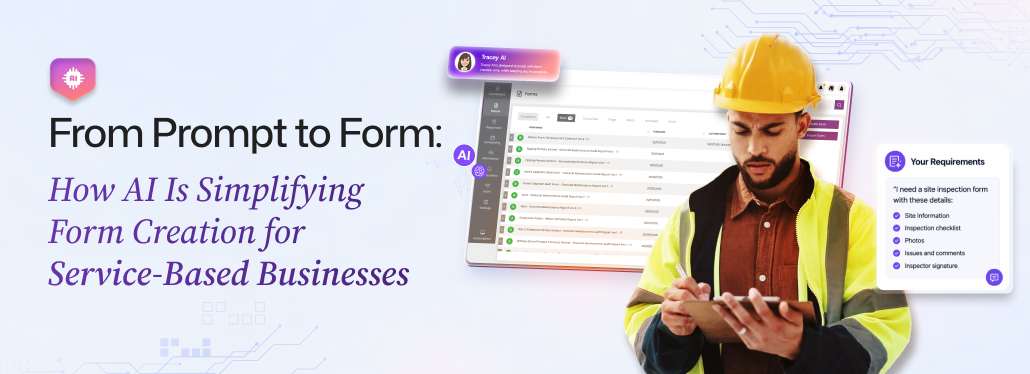
- Tapapp’s AI assistant Tracey integrates functions such as creating, submitting and reporting within a single platform.
The Future of Service Businesses Begins with AI Forms
What if creating a digital form takes less time than filling one out?
Service-based industries, such as cleaning or grounds maintenance, rely on forms to manage their day-to-day operations. But what’s the main purpose of introducing forms into daily workflow? The answer is simple: it is structured data collection.
From site inspections and audits to incident reports and other procedures, digital forms play a crucial role in capturing data securely and accurately. The integration of AI has made the task of form creation easier and faster at the same time.
Unlike manual form creation, AI-powered form creation can generate a ready-for-use digital form that can be optimised to meet industry-specific requirements.
Why Are Businesses Transitioning from Manual to Automated Form Building?
Manual form building has reliably supported service-based organisations for a long time, but it comes with specific limitations that make a transition to a more efficient approach necessary.
➡️ More Time-Consuming
Manual form building means working through each field one by one, including deciding what to include and formatting the layout. This process takes a great deal of time and often slows down service delivery.
➡️ More Headcount, Less Productivity
Generally, manual form building requires the involvement of multiple employees. For this reason, employees spend time on repetitive tasks, which diverts them from high-value tasks.
➡️ Inconsistent Layout
When forms are built manually across different sites or teams, the layout of the forms differ. During the time of final audit, these variations in formatting and layout create confusion for managers and supervisors.
What “AI-Powered Form Creation” Actually Means
The first generation of manual form builders allowed users to create forms without programming knowledge and made the process relatively simple in comparison to the paper-based form creation.
Although these digital forms were revolutionary at that time, users were required to manually configure each element. However, the integration of AI solutions into existing platforms has transformed the process, and AI-powered pre-built templates can help service-based businesses to streamline form creation.
AI-based form creation platforms work in two ways: text-based and image-based.
- Text-Based Form Generation: By utilising this feature, managers can add their requirements in text format and can accordingly generate structured forms.
- Image-Based Form Generation: This specific feature enables supervisors to add existing photographs of the inspection sheets or checklists to get ready-to-use forms.
The Mechanics Behind AI-Powered Form Building
At the heart of the AI-driven form creation process lies sophisticated AI technology, and this process also follows a structured approach to execute each task accurately.
🔷 Photo-to-Form Conversion
Existing paper-based checklists, audit forms, or inspection sheets can all be digitised by attaching photographs of them. This eliminates the need to manually rebuild their layouts.
🔷 Natural Language Form Generation
Other than the photographs, a short text-based description, and site audit-related data items can also be used to generate specific forms.
🔷 Smart Field-Type Detection
AI instantly recognises whether a field requires a photo upload, signature, or GPS tag, helping make the form creation process more efficient.
🔷 Industry-Related Template Suggestions
AI can also suggest a range of templates that suit common service-based industry scenarios, such as cleaning checklists or equipment inspection lists.
🔷 Conditional Logic Assistance
Based on user prompts or requirements, AI can add or remove the fields. It is ideal for incident reporting, where the follow-up questions can vary based on the nature of the incident.
🔷 Compliance-Aware Structuring
Forms can be easily aligned with relevant industry standards or frameworks to reduce the risk of non-compliance and potential legal issues.
🔷 Faster Replication Across Sites
A form created for a specific location or for a specific client can easily be replicated or updated through AI, and at the same time, consistency across multi-site operations.
Key Benefits of Using AI-Powered Forms for Service Businesses
When it comes to AI-driven forms, speed is the first and foremost advantage that service-based businesses consider. Beyond speed, AI-led form creation has multiple other benefits which are contributing to the efficiency of the operational workflow.
▶️ Easy Accessibility for Site-Level Staff Members
Although manual form building was quite beneficial in every way, AI-assisted form creation increases the accessibility factor for the staff members. Utilising AI-assisted form builders, staff members can create forms and fill them with ease.
▶️ Consistency Across Sites
When the form structures differ from one location to another or from one department to another, it creates confusion. AI form creation tools offer pre-built, industry-specific templates which aid in maintaining uniformity across the multi-site operations.
▶️ Lower Dependency on a Single Employee
AI eliminates the sole dependency on one technically skilled team member and makes form-creation capabilities more accessible across the organisation.
▶️ Better User Experience
AI-driven form builders not only improve the experience of the form creators but also that of respondents. By identifying patterns and incorporating best practices, AI-generated forms offer better usability.
Where AI-Driven Form Creation Is Heading Next?
The form-creation capabilities AI currently offers, such as developing forms from texts or photographs, are just the early stages of what is possible. For service-based industries, the role of AI in form creation is anticipated to grow in multiple directions.
🔶 Predictive Form Generation
Depending on service type, site history, and previous patterns, AI may eventually be able to suggest modified form structures. Over time, it may be able to generate a wider range of templates.
🔶 Voice to Form Generation
Besides the text and photographs, the advanced AI form generators may also be able to create forms based on verbal requirements of the site staff members. Through this feature, a technician or a cleaner would be able to verbally request a form.
🔶 Auto-Updating Compliance Forms
In the future, it is expected that the AI-based smart form generators may be able to auto-update the fields based on evolving industry compliance standards. Unlike periodic updates, continuous updating could improve operational efficiency for service-based businesses.
🔶 Tighter Integration with Scheduling and Reporting
Future AI-led form generators may increasingly integrate with broader operational workflow to support better workforce management. As a result, form creation task may become a significant part of the operational workflow instead of being a standalone task.
How Tapapp’s Smart Forms Are Changing the Way Service-Based Teams Work?
Manual form creation has reliably supported the service-based industries. AI-led form creation is becoming increasingly common, and service-based businesses are adopting it for additional benefits.
As all-in-one workforce management platform, Tapapp’s smart forms are built around its AI assistant, Tracey.
Tracey lets the users add photographs of paper-based forms or enter requirements in text format to generate live digital forms. So, no more re-entering the same data across different applications. With Tapapp, you can create forms, submit them, and report from a single platform.
Take the first step toward a simple way of working.
Frequently Asked Questions
AI-generated forms are entirely editable. AI’s main role is to create a basic form based on your requirements or photos. However, as per your business requirements, you can re-edit, rearrange, remove, or rename the fields.
AI comes in handy in both places for creating new forms and for updating the existing ones. Instead of manually locating and editing field by field, with the help of AI, you can just describe the change that is required.
AI form generation platforms mostly rely on cloud-based processing, so an internet connection is required during form creation. However, Tapapp lets you use completed forms offline.
Since photographed forms and text requirements contain confidential business data, the AI-based form builders are designed to protect user privacy in every possible way. We recommend that users verify the data protection measures and standards followed by the applications before opting for a paid subscription.
Tapapp hosts data on UK-based servers and implements strong data protection measures. We strictly adhere to GDPR requirements to reduce the risk of non-compliance.