
Key Takeaways:
- Digital transformation is not about just swapping the tools, but it is about rethinking how a service business operates.
- There are five core areas of digital transformation for service businesses that include replacement of the spreadsheet with digital forms, digital attendance tracking, shift scheduling, shareable digital reports, and centralised visibility.
- Every service sector gets measurable benefits from the digital transformation in the form of live status tracking to compliance checks, job updates, and others.
- As a key part of digital transformation, Tapapp is reshaping operations with three core features, such as smart forms, attendance, and scheduling.
The Shift That Every Service-based Business Can Feel Coming
Over the past few years, the service industry worldwide has changed dramatically as waves of digital transformation have swept through it. Gone are the days when the service industry only meant paperwork and manual spreadsheets.
Today, the service industry is no longer stuck in the manual aspects, and it is switching to advanced digital methods to stay afloat to changing customer expectations.
No matter if you are running a commercial cleaning company or a landscaping business, the pressure of keeping the clients satisfied remains the same everywhere.
Are you striving to navigate the stream of digital transformation in your service-based business? Let’s find out the digital transformation trends which are reshaping business operations.
What Digital Transformation Actually Means for Service Businesses
People often mistake digital transformation for software upgrades. However, digital transformation is about rethinking and redesigning the way your business operates, and technological solutions only simplify the procedures.
For the service industry, digital transformation stands for:
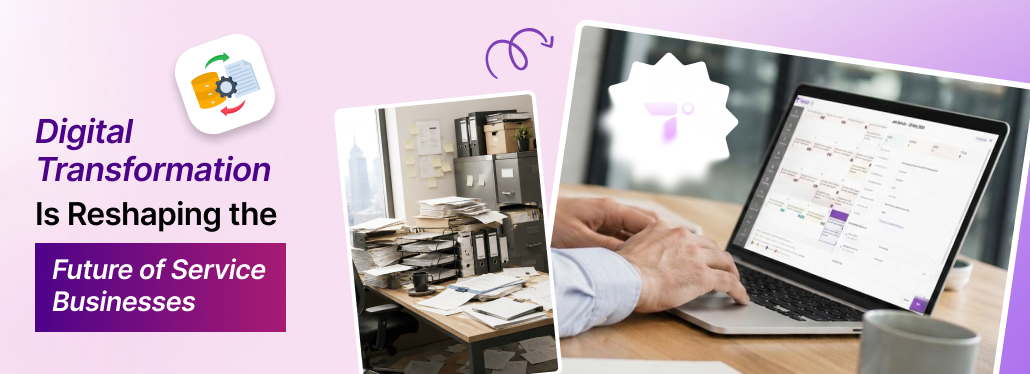
- Replacing The Manual Spreadsheets with Smart Forms: The new-age software and applications are designed for securely storing and capturing data instead of the manual way, which often leads to error or missing track record.
- Tracking Time and Attendance: Instead of manual sign-ins, digital attendance and record-keeping through GPS tracking and QR codes are becoming prominent in service-based businesses.
- Scheduling Jobs and Shifts: The service-based business endeavours these days are moving towards a connected ecosystem for job scheduling by replacing the whiteboards, phone calls and other manual means.
- Transforming Field Data into Shareable Digital Reports: Earlier, managers were bound to rely on field data; now, organisations are choosing to transform it into shareable digital reports.
- Enhancing Visibility: Through smart forms, attendance, and scheduling, the agile software is ensuring that managers and business leaders have direct access to a clear picture in a single system.
The Real Cost of Staying Manual in a Service-Based Business
Most service-based business still lack knowledge about the real cost of relying on the manual process. The cost mainly stems from three core areas of the service industry.
➡️ Slow Audits and Poor Visibility
When paperwork overwhelms business operations, tracking who completed a task, when it was completed, and why it was performed becomes extremely time-consuming. As a result, audits get delayed, while low visibility creates risk factors that may impact the operation.
➡️ Incomplete Reporting and Unreliable Data
Just picture this: if you encounter inconsistent, missing records or absent signatures on paper, how much complexity can they add to the operations?
In such cases, it seems to be extremely challenging to validate the reports and to answer the questions asked by the client regarding the service.
➡️ Client Dispute and Compliance Issues
When accurate digital records are missing, how will you continue to ensure SLA compliance? This is the major pain point where the clients lose trust, and at the same time, contracts may be put at risk.
The Benefits of Digital Transformation for Service-Based Businesses
To put it simply, digital transformation is not just about keeping up; rather, it is about staying ahead in the race by outpacing the competitors.
When executed in the right way, digital transformation begins to reveal its tangible benefits. Let’s find them in the pointers below.
🔷 Improved Workforce Productivity
Easy check-ins, fast-paced scheduling, and streamlined communication across the teams helps boost productivity.
For instance, when you can clearly see each step of how the service is getting delivered to the clients, or to whom it is assigned, or within how much time the workers have to finish the task, you can plan the next steps accordingly.
🔷 Faster Completion of Tasks
Digital job allocation and easy attendance tracking ensure that the right employee receives the right task instantly. It reduces the delay in service delivery and minimises the waiting time for the clients.
🔷 Reduced Operational Expenses
Elimination of paperwork can improve resource utilisation and reduce operational costs in a significant manner.
🔷 Better Business Insights
Digital platforms help generate valuable business data and reports for identifying trends, supporting the process of strategic planning, and measuring performance.
🔷 Stronger Compliance
Once you have digital records in your system ready, you will be able to conduct the audits easily to ensure safety, certifications, and other benefits. It will make compliance a breeze for the organisations.
🔷 Superior Customer Satisfaction
Real-time updates at each stage, faster service delivery, and a complete digital report help to strengthen the relationship with clients through utmost transparency.
Digital Transformation Across Different Service Industries
Every service-based business is unique, and so are its challenges. However, the right choice of digital transformation strategy and its accurate implementation can bring positive differences in business operations.
Here are some service-based businesses and how they derive benefits from digital tools.
🔶 Commercial Cleaning
Cleaning businesses, by utilising digital software solutions, can assign jobs digitally, verify daily attendance, capture before and after images, complete the cleaning checklists, and generate reports for the clients.
🔶 Housing Services
Housing service providers can streamline property inspections, tenant visits, maintenance requests, and compliance checks.
🔶 Facilities Management
Facilities management teams take part in improving the visibility across multiple sites by coordinating jobs, tracking progress, managing forms, and monitoring task progress from day one.
🔶 Grounds Maintenance and Landscaping
By using advanced features, the grounds maintenance and landscaping companies can optimise routes, monitor attendance, and document the completed works. It aids in enhancing the satisfaction of the customers and keeping them updated.
🔶 Field Service & Maintenance
In field service and maintenance, the engineers can receive updates regarding the job, update the status, and submit reports once done.
Related Articles:
From Prompt to Form: How AI Is Simplifying Form Creation for Service-Based Businesses
How Is Tapapp Changing the Trajectory of Service Businesses?
Tapapp is designed based on a simple vision: to replace multiple devices in the operations and to synchronise the key processes for offering a seamless experience to the users.
The app is focused on three core areas, such as smart forms, attendance, and scheduling, for simplifying workforce management. Instead of juggling with the separate logins, subscriptions, and disconnected devices, Tapapp brings everything under a single dashboard.
Ready to move your service business forward? Start your digital transformation with Tapapp.
Frequently Asked Questions
Poor connectivity is one of the major concerns for field-based service businesses that deal with numerous projects in basement areas, remote locations, and others. Tapapp is designed with offline functionality that supports the workforce to complete forms, log attendance, and update the job status anytime and anywhere without network connectivity. Once the device receives a stable network, it automatically synchronises all the details.
The manual records and entries make it utterly challenging for businesses to maintain compliance. On the other hand, digital transformation replaces the manual hassle with GPS-logged attendance, photo and signature evidence, and instantly generated reports. These advanced measures make it easier to adhere strictly to SLA requirements.
Phone calls and check-in texts are no longer the reality of service-based businesses. Rather, these organisations nowadays are relying on digital procedures. Tapapp’s live job status and GPS-based check-ins are simplifying the process of monitoring without creating interruptions in the job through calls and texts.
Yes, absolutely. Instead of collecting paper forms or accumulating manual data items, the digital systems and applications take part in generating reports automatically by processing the field data sets.
Yes, transparency in the process is one of the major benefits of digital transformation that organisations are currently capitalising on. Digital platforms such as Tapapp present a user-friendly interface so that the clients can track the work progress through a centralised dashboard.