
Key Takeaways:
- Audit-ready records benefit service providers to improve accountability and compliance across operations.
- Poor records keep increasing risks related to SLA failures, payroll errors, and disputes.
- Workforce management software creates verifiable and structured records while reducing administrative workload.
Why Are Service Businesses Under Increasing Pressure to Prove Work?
Say your client asks for proof of work for a job completed last week. Alongside, an SLA review is scheduled for the next day, but service reports are spread across paper forms. Additionally, as a manager, you need to record attendance for your team who are on the way to their next site.
Sounds chaotic, right?
Many service providers operate under such situations. As the business scales and compliance requirements become stricter, depending on a traditional system makes operations even more overwhelming in order to prove work completion, maintain compliance, and report faster across operations.
The gaps show up silently at first, and then all at once. This is why audit-ready records are more of an operational necessity, and an advanced workforce management system becomes essential.
Why Traditional Record Keeping No Longer Works for Service-Based Business?
Compared to traditional record-keeping systems, service operations today move much faster than what one could have anticipated in the past.
Schedules change, teams work across multiple sites, and clients expect transparency and faster reporting. Several processes still rely on disconnected components, making visibility difficult.
🔷 Manual Documentation Causes Operational Gaps
Paper forms and manual entries increase the risk of incorrect information and inconsistent reporting. When multiple teams record information in different ways, accuracy becomes difficult to maintain.
🔷 Paper Records Slow Down Verification Processes
When a client questions a visit or a manager needs confirmation of the work, the paper-based system isn’t enough. What should take minutes ends up taking days. In time-sensitive situations, these delays cause real commercial risks.
🔷 Disconnected Systems Impact Visibility
Many service providers depend on separate tools and systems for attendance, scheduling, reporting, and communication. This way, information gets scattered across multiple systems, and managers lose visibility, the one thing that is highly essential in everyday operations today.
🔷 Missing Information Leaves Businesses Exposed
Dealing with undated entries and unverified locations? These are not just administrative oversights. In case of a dispute or compliance review, these are the differences between a business that can defend itself with its records and one that cannot.
What are Audit Ready Records in Field Operations?
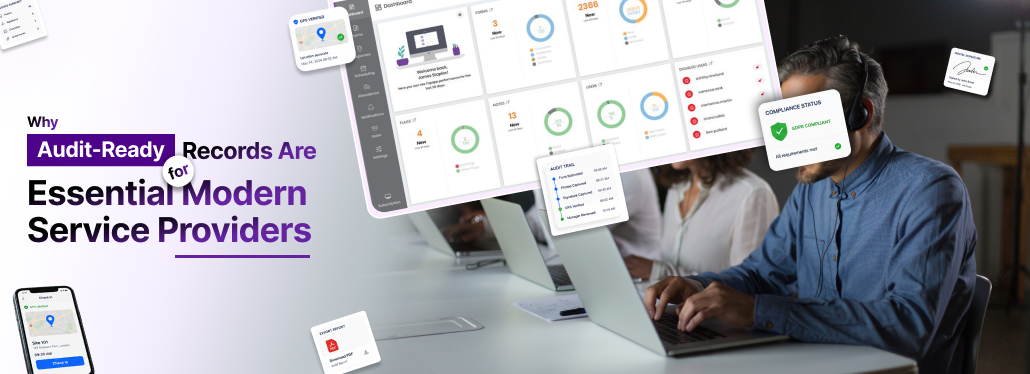
Audit-ready records are usually structured and verifiable records that help businesses to prove that the work was completed on the designated date, time, and place. In place of relying on manual sheets or fragmented paperwork, audit-ready records maintain a clear history of operations that can be accessed anytime and from any place.
Here are some common examples of the same:
- Time-stamped records: Every work is logged at the precise time and date it occurred, automatically and without manual entry or detailed recall.
- Attendance logs: A proper workforce management system records and shows clock-in and out and shift activities to verify staff presence.
- Proof of work documentation: Completed checklists, photos, notes, signatures, and evidence collected during the service delivery. This validates the completion of work.
- Inspection records: Compliance checks and flagged issues are captured immediately after a site visit.
- Service reports: Job summaries are automatically generated once the job is completed, ready to share with clients or retain for internal review.
- Digital approvals: Sign-offs from managers or clients replace paper signatures with time-stamped confirmations.
All of these components form a standard that supports daily operations. It also strengthens the internal system in case of disputes or an external audit.
Why Are Service Providers Facing Pressure for Transparency of Work?
With the advancement of technology, service providers today are expected to do more than just get the work done. Be it clients, managers, or employees, everyone expects visibility into what was delivered, what happened, and whether commitments were met.
When operations scale, meaning it becomes more distributed, maintaining transparency without proper systems becomes quite difficult.
Across industries, each member involved in the task is requesting more evidence and assurance.
▶️ Clients Expect Proof of Service
Reassurances don’t work anymore. Clients are expecting businesses to provide proper evidence that the agreed work was done properly. When it involves landscaping, cleaning, or maintenance, businesses should provide clear records rather than paper trails.
▶️ Compliance Requirements Continue Increasing
Regulatory requirements across different industries increasingly require records to be timestamped, accurate, and retrievable. Meeting compliance means having records that can be produced at any given time and withstand external review.
▶️ Multi-Site Operations Need Centralised Visibility
Modern workforce management software provides unified visibility across the site. When a business operates in various locations, inconsistencies in work become a common issue. A manager overseeing 10+ sites cannot be physically present at every site. In such situations, having a well-connected system is highly important to link field activities into a single record and avoid blind spots.
▶️ Contract-Based Businesses Need Stronger Documentation
Service-based businesses that operate under contracts and SLAs require documented evidence to demonstrate the completion of assigned work. When you have a well-organised record of the work, managers appear more confident and stop struggling with a lack of operational control.
Older systems are becoming difficult to scale for reporting, attendance tracking, and scheduling. Workforce management software helps businesses do it all under one roof, making it easier to ensure transparency without administrative burden.
What are the Operational Risks of Poor Record Keeping
Admins struggle due to poor record-keeping because weak documentation rarely causes issues on a good day, but the damage becomes visible just when something goes wrong. The lack of proper records makes it even tougher to resolve.
➡️ Mishandling of Information
A weak record results in even the most reliable staff exposing your organisation to compliance and legal risks by unintentionally handling documents. If a client questions whether the visit took place at the same time or the job met the agreed standard, the burden falls on the client’s shoulders. However, with a time-stamped record, everything aligns, and the client gains your trust.
➡️ SLA Failures Become Difficult to Investigate
Missing an SLA is quite costly. Without precise records of attendance, job timelines, service history, or completed work, service providers fail to identify where failures occur and how to curb them from recurring in the future.
➡️ Increase in Payroll and Workforce Discrepancies
Manual timesheets can lead to inconsistencies and errors. When attendance isn’t properly tracked, discrepancies between hours worked and hours paid are hard to spot. With time, these small conflicts add up, which impacts both staff trust and costs.
➡️ Audits Become More Time-Consuming
Browsing through paper records, emails, and disconnected systems increases the time required during audit and compliance checks. Instead of accessing information, businesses spend valuable time gathering fragmented records.
➡️ Lost Records Create Financial Risk
Missing documentation creates financial consequences. Delayed invoicing, compliance penalties, and legal risks of visits can increase costs and affect business performance. Without a proper system of record, businesses spend additional time and resources recreating information that should already exist.
Industries Where Audit-Ready Records Have Become Critical
Accuracy is something non-negotiable, and it sure is pressure because businesses need to document records. It’s not limited to one type of business; across diverse service industries, the expectation that field activity can be verified and retrieved on demand has become a basic requirement for clients, regulatory frameworks, and the increasing complexity of contract-based operations.
In such a scenario, Tapapp does an excellent job. Our all-in-one workforce management software eliminates the need to chase paperwork or manually compile reports, and records are created automatically rather than being collected later on.
🔶 Cleaning Service Providers
- Multi-site cleaning projects require proof of completion of work
- Clients demand accurate service documentation, making audits necessary
Tapapp: Allows cleaning teams to capture photos, signatures, attendance proof, and service completion digitally.
🔶 Facilities Management Companies
- Several functioning sites create visibility and reporting issues
- Contract performance requires a precise operational record
Tapapp: Centralises workforce activities, reporting, and scheduling all across different locations.
🔶 Grounds Maintenance Teams
- Recurring services require well-documented service delivery records
- Remote teams decrease visibility into site-level operations
Tapapp: Thanks to timestamped records along with proof-of-work for completed visits.
🔶 Security Operations
- It is verified workforce attendance upon which site accountability depends on
- Accurate shift and patrol recordkeeping is essential for regulatory adherence
Tapapp: GPS-enabled attendance offers complete transparency and audit-ready records.
What Makes Operational Records Audit-Ready for Service Providers?
It’s easy to create records, but tough to ensure they’re credible, especially when they’re examined. Operational records allow service providers to understand what happened without manually collecting information later.
- Time-stamps: Knowing when work started, paused, and completed helps businesses understand job timelines, productivity, and service delivery patterns without relying on manual updates.
- Location verification: For multi-site operation, GPS-backed location verification becomes important. Workforce management software helps businesses monitor progress without relying on manual confirmation.
- Proof-of-work: A completed job status rarely explains what actually happened. Photos, readings, and completed forms provide context beyond simple task completion.
- Digital signature: Digital approvals provide clear confirmation points between managers, contractors, and teams, reducing back-and-forth communication after work is completed.
- Real-time data: Information collected during the service is more accurate than reconstructed hours later.
- Secure storage: Workforce management software centralises workforce data, forms, and records, so teams spend less time going through emails and disconnected systems.
Business Outcomes Service Providers Gain from Audit-Ready Records
For many businesses, audit-ready records are initially introduced to meet compliance requirements. Better records create faster decision-making and fewer day-to-day bottlenecks.
1️⃣ Faster Client Reporting
- Connected workforce management systems bring service records and activity logs into a streamlined workflow
- Reports previously took hours to compile are generated within minutes
2️⃣ Workforce Accountability
- Structured reports give supervisors visibility into day-to-day operations and progress
- Accountability improves across sites without manual supervision
3️⃣ Better Operational Visibility
- Disconnected systems create blind spots, but a centralised data system removes friction between teams and locations
- Managers gain a clear picture of performance and operational status without having to be physically present
4️⃣ Reduced Administrative Burden
- Less time spent on compiling reports and timesheets
- Reports are automatically generated in the field, shrinking the administrative workload
5️⃣ Faster Dispute Resolution
- Queries around attendance or service quality become easier to navigate when records are accessible
- What took days to compile gets resolved quickly
Why Workforce Management Systems Are No Longer Optional
From risk to readiness, the workforce management system is a complete game-changer in the UK’s highly competitive landscape. Missed audits, unresolved disputes, and compliance failures lead to major consequences that cannot withstand scrutiny.
Sure, the risk is real because regulatory frameworks across service-based industries continue to tighten. Businesses relying on traditional software or paper records are carrying a liability that only compounds. However, by then, the damage to client relationships and compliance positions has already been done.
Audit-ready workflows aren’t built overnight, but with the right infrastructure, they can be built faster and built right.
AI-powered workforce management software in the UK, such as Tapapp, brings digital forms, scheduling, attendance, and automated reporting into a centralised system.
For service providers navigating growing compliance demands and client expectations, the question is whether the system currently in place can produce them.
Frequently Asked Questions
Yes, clients expect audit reports. We share these reports with clients to ensure visibility into completed work and service quality. Instead of answering calls, we provide records that show what happened and when.
Not really. We prefer controlling what information is shared depending on projects, client needs, and contracts. The goal is transparency without exposing unnecessary data and workforce information.
Workforce management software scales with the business, no matter whether you operate a single or multiple sites.
Incomplete records during an audit shift the burden of proof onto the service provider. Depending on the industry, consequences range from warnings to financial penalties to contract suspension, according to the regulatory body.