Key Takeaways:
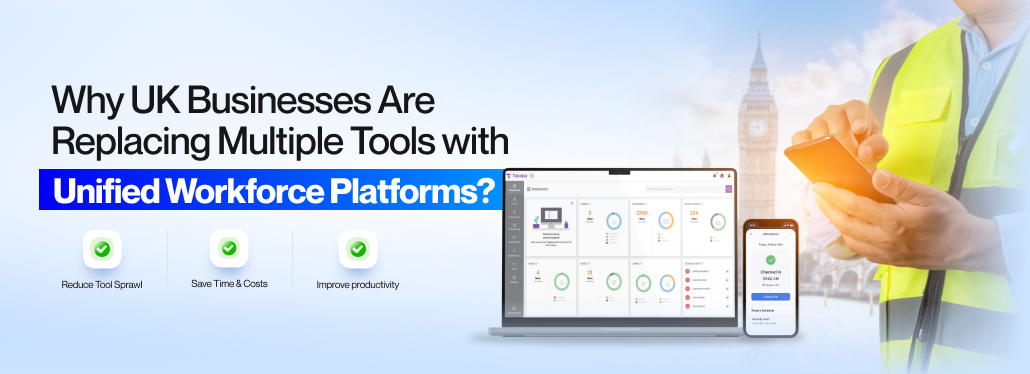
- UK businesses are replacing disconnected workforce tools via unified platforms for enhancing operational efficiency, workforce visibility, and communication across multi-site operations.
- An all-in-one workforce management system helps decrease administrative workload by centralising scheduling, tracking of attendance, reporting, compliance, and workforce coordination within a single platform.
- Real-time workforce visibility, automated workflows, and mobile access are becoming crucial for industries such as cleaning, facilities management, logistics, maintenance, and field services.
- Unified workforce platforms assist businesses in enhancing compliance, decreasing operational errors, strengthening accountability of the workforce, and providing better service transparency to clients.
- Modern workforce management software UK solutions are evolving into intelligent operational ecosystems, supporting faster decision-making, scalability, and long-term growth of businesses.
The Growing Shift Toward Unified Workforce Platforms in the UK
Several UK businesses still depend on different tools for scheduling, tracking attendance, reporting, inspections, and workforce communication. While these systems may handle individual tasks, they mostly develop disconnected workflows, duplicated admin work, poor visibility, and operational inefficiencies. As workforce operations become more complicated, businesses are largely shifting towards centralised or unified platforms to centralise them all in one place.
Modern workforce management software UK solutions bring together scheduling, attendance, reporting, and workforce visibility into a single operational ecosystem. This helps businesses in decreasing manual processes, enhancing coordination, optimising communication, and getting real-time control over field work. Starting from management of facilities to cleaning and service sectors, UK businesses are replacing fragmented systems with centralised workforce platforms to enhance accountability, efficiency, and long-term operational performance.
The Problem with Using Multiple Workforce Tools
Several UK businesses still utilise different platforms for attendance, scheduling, reporting, inspection, and communication. While these tools help in solving individual tasks as well as disconnected systems mostly create poor visibility, inefficiencies, gaps in communication, and increased administrative work. This is the reason why businesses are now largely adopting an all-in-one workforce management system for centralising operations as well as streamlining workforce management.
🔷 Disconnected Systems Create Operational Silos
When workforce information is spread across several tools, businesses struggle to maintain operational consistency. Teams mostly face gaps in communication, delays in updates, and disconnected workflows across sites and departments.
🔷 Manual Processes Increase Administrative Work
Handling several systems requires constant manual entry of data, consolidation of reports, and repeated updates. These repeating processes take valuable time and decrease overall workforce productivity and operational efficiency.
🔷 Limited Real-Time Workforce Visibility
Fragmented systems make it complicated for managers to track attendance, progress of the shift, workforce locations, and operational updates in real-time, decreasing visibility and slowing down operational decision-making.
🔷 Increased Risk of Errors and Compliance Issues
Disconnected tools increase the chances of errors in payroll, missed shifts, duplicate records, outdated schedules, and incomplete reports, developing operational risks as well as potential compliance challenges for businesses.
🔷 Poor Workforce Communication and Employee Experience
Employees utilising multiple apps for attendance, schedules, and communication mostly experience confusion and inefficiencies in the workflow, mainly in field operations and multi-site environments of the workforce.
🔷 Rising Software Costs and Operational Complexity
Handling multiple integrations, subscriptions, vendors, and onboarding processes enhances operational complexity, and long-term, the costs of the software, making fragmented workforce systems difficult to handle efficiently.
Why UK Businesses are Now Prioritising Operational Efficiency in 2026?
Operational efficiency has now become a huge priority for businesses in UK in 2026. Rising the costs of labour, staffing shortages, as well as increasing compliance needs and making workforce management more challenging across sectors such as maintenance, cleaning, logistics, facilities management, and field services. Businesses are under constant pressure to enhance productivity while maintaining the quality of service and controlling the costs of operations. Even small inefficiencies in attendance tracking, scheduling, and attendance tracking, reporting or communication can affect customer satisfaction and profitability.
At the same time, businesses require speedy decision-making and real-time workforce visibility to handle multi-site operations more effectively. Managers now need immediate access to schedules, attendance records, workforce locations, as well as operational updates for responding faster to disruptions as well as service delays. As the competition is growing continuously, digital workforce operations have become a major business advantage. Companies that enhance operational efficiency can decrease administrative workload, enhance workforce coordination, strengthen compliance, and improve client retention. In the present-day market, efficiency is not operational anymore; it is directly connected to profitability and long-term growth.
Key Reasons UK Businesses Are Switching to Unified Workforce Platforms
The businesses in the UK are now shifting to a unified workforce platform. Here are the reasons why:
➡️ Decrease Administrative Work
One of the biggest reasons why businesses are adopting workforce management software UK solutions is to decrease the growing administrative burden because of disconnected systems. Handling separate platforms for scheduling, attendance, reporting, inspections, and payroll mostly results in duplicate entry data, repetitive manual tasks, and unnecessary paperwork. Managers are frequently spending hours transferring information between updating spreadsheets, systems, and generating reports manually.
Unified workforce platforms optimise these processes via automated workflows, centralised reporting, and connected operational data. Attendance records can automatically sync with payroll systems, schedules can be updated in real-time, and reports can be immediately generated from a unified dashboard. This largely decreases paperwork, saves administrative costs, and enhances operational efficiency.
Industries such as grounds maintenance, cleaning, and service operations are at the utmost advantage as they handle a huge volume of multi-site workforce activities every day. By centralising the workforce processes within a single system, businesses can decrease manual workload as well as focus more on operational service delivery and operational performance.
➡️ Better Real-Time Workforce Visibility
Modern field operations need real-time workforce visibility for maintaining service quality and efficiency. Businesses handling mobile teams across multiple locations require immediate access to workforce locations, attendance records, active shifts, and operations updates. However, fragmented systems mostly make it difficult to get a full operational view.
Unified workforce platforms offer a centralised visibility via features such as live workforce tracking, GPS attendance, real-time shift monitoring, and immediate operational updates. Managers can easily find out rescheduling conflicts, delays in tasks, workforce shortages, or absenteeism without depending on different disconnected tools.
This level of visibility is mainly crucial for industries such as facilities management, cleaning, and logistics, where operational delays directly affect customer satisfaction and SLA performance. Centralised workforce visibility helps businesses enhance accountability, streamline workforce coordination, and respond to operational disruptions in a timely manner.
➡️ Enhanced Compliance & Audit Readiness
Compliance management has become largely crucial for UK businesses handling public-sector contracts, council operations, and facilities management agreements. Businesses are expected to maintain accurate records of the workforce, offer proof of completed work, and meet strict SLA needs. Manual systems and fragmented platforms often make compliance tracking difficult and increase the risk of reporting errors.
Unified workforce platforms enhance audit readiness through digital audit trails, timestamped records, proof-of-work documentation, and centralised compliance reporting. Features such as GPS attendance, digital inspections, and automated reporting help businesses maintain accurate operational records while enhancing transparency across workforce operations.
Several modern workforce management software UK solutions are developed with a GDPR-conscious operational system. This helps businesses securely handle the data of the workforce while meeting compliance standards. This is especially valuable for businesses handling sensitive operational information or working within regulated systems.
➡️ Stronger Employee Experience
Employees working with several disconnected applications mostly face outdated schedules, communication gaps, and inefficient workflows. Switching between different platforms for communication, attendance, reporting, and scheduling can cause frustration and decrease software adoption among the field teams.
Unified workforce platforms streamline the experience of employees by centralising the activities of the workforce within a single connected system. Employees are capable of accessing schedules, tools of attendance, communication updates, and operational tasks from a single platform. Features such as instant notifications, self-service scheduling, and faster approvals enhance workforce coordination and decrease confusion.
Enhanced transparency also helps the employees remain informed about the changes in the schedule, assignment shifts, and operational updates in real time. By easing out workforce interactions, unified systems enhance employee adoption, decrease operational friction, and support improved workforce engagement.
➡️ Faster Decision-Making Through Centralised Data
Businesses that depend on disconnected workforce systems mostly struggle with fragmented operational information and delayed reporting. Managers may be required to collect data from several sources before making decisions related to the workforce, slowing response times as well as decreasing operational agility.
Unified workforce platforms centralise operational information within a single dashboard, offering businesses real-time analytics, performance visibility, and workforce activity. Managers are capable of accessing attendance records, shift performance, workforce activity, and operational reports immediately, helping them make speedy and informed decisions.
Unified data also helps in supporting better forecasting, optimisation of the workforce, and long-term operational planning. Instead of reacting to operational problems after they have surfaced, businesses can proactively find out inefficiencies and enhance workforce performance more effectively.
➡️ Lower Software Complexity & IT Overhead
Handling multiple workforce tools mostly enhances the complexity of the software over time. Businesses may require maintaining various vendor relationships, handling several integrations, training employees across several systems, and handling continuous issues related to software compatibility. This kind of fragmented approach enhances operational costs and develops unnecessary IT overhead.
Unified workforce platforms help in simplifying technology management by consolidating workforce operations within a single connected ecosystem. Businesses get an advantage from fewer vendors, easy onboarding, simplified integrations, and decreased software fragmentation. This does not just decrease long-term operational expenses but also enhances the usability of the system and workforce adoption.
As businesses continue to give priority to scalability and efficiency, several businesses are now moving away from stakeholder tools and selecting a platform consolidation instead. A centralised workforce platform offers a more cost-effective, scalable, and operationally efficient approach for handling modern workforce operations.
Industries in the UK Leading the Shift Towards Unified Workforce Platforms
Multiple operational industries all over the UK are rapidly adopting an all-in-one workforce management system to enhance visibility, optimise workflows, and streamline workforce coordination. Businesses handling field teams, multisite operations, and compliance-heavy services are seeing the greatest value from a centralised workforce platform.
🔶 Facilities Management
Facilities management companies depend on unified platforms to handle SLA tracking, engineer coordination, monitoring of attendance, and multi-site operations more efficiently. Unified systems help in enhancing operational visibility, decreasing delays, and streamlining workforce scheduling across several client locations.
🔶 Commercial Cleaning
Commercial cleaning businesses utilise centralised workforce platforms for validation of attendance, proof-of-work reporting, recurring scheduling of contracts, and accountability of the workforce. A unified system enhances operational transparency, simplifies audits, and maintains operational consistency across several cleaning sites.
🔶 Grounds Maintenance
Grounds maintenance businesses get an advantage from mobile tracking of the workforce, seasonal scheduling, digital inspections, and compliance reporting. An all-in-one workforce management system helps businesses in handling field operations more effectively while enhancing workforce visibility and operational coordination.
🔶 Service & Maintenance Businesses
Service and maintenance businesses are largely adopting unified platforms to enhance field engineer visibility, digital inspections, reactive maintenance coordination, and operational reporting. Real-time workforce data helps businesses to respond to service requests faster and decrease operational delays.
🔶 Logistics & Field Services
Logistics and field service businesses need coordination of routes, live workforce updates, mobile reporting, and real-time communication to handle everyday operations efficiently. Centralised workforce systems enhance scheduling accuracy, tracking of the workforce, and operational responsiveness.
🔶 Social Housing
Social housing providers are utilising unified workforce platforms to handle maintenance teams, coordination of contractors, compliance reporting, and tenant service operations. Centralised workforce management enhances operational transparency, service response times, as well as workforce accountability across house operations.
The Role of Mobile-First Workforce Platforms in Modern UK Operations
Modern workforce operations are not limited to office-based environments. Sectors such as facilities management, cleaning, maintenance, field services, and more now largely rely on mobile teams operating across several locations. This kind of evolving shift towards field-based operations is driving organisations to adopt mobile-first workforce management software UK solutions, supporting workforce visibility, real-time communication, and operational flexibility.
▶️ Real-time Workforce Access Enhances Operational Efficiency
Mobile-first workforce platforms enable employees as well as managers to access schedules, reports, attendance records, and operational updates directly from tablets or smartphones. This enables businesses to enhance coordination, decrease delays, and respond faster to operational changes.
▶️ Better Workforce Visibility Across Field Operations
Features such as GPS attendance, live tracking of workforce, and immediate notifications offer managers visibility in real-time into workforce activity. Businesses are capable of monitoring employee locations, shift progress, and operational updates more efficiently across several sites.
▶️ Digital Workforce Decreases Paper-Based Processes
Mobile workforce platforms help in simplifying reporting, inspections, proof-of-work documentation, and communication via digital workflows. Employees are capable of submitting reports, finishing inspections, capturing photos, and updating tasks directly from the field without depending on paperwork.
▶️ Offline Functionality Supports Remote Teams
Several field employees work in low-connectivity environments where internet access may be limited. Mobile –first workforce platform, while the offline functionality enables the team to keep on working efficiently while syncing operational information once connectivity is restored.
▶️ Mobile Workforce Technology Supports Modern Business Growth
As the businesses in the UK go on to prioritise operational efficiency and workforce accountability, mobile-first workforce management software UK solutions have become necessary for enhancing transparency, coordination, and service delivery and transparency across modern field operations.
Future Trends: The Next Evolution of Workforce Management Platforms
The future of workforce operations is now becoming majorly automated, digital, and data-driven. As businesses continue to handle complicated field operations and mobile workforces, modern workforce management software UK platforms are changing beyond basic scheduling and tracking of attendance into intelligent operational ecosystems. Businesses are now searching for unified platforms that enhance workforce visibility, automate repeating tasks, and support speedy operational decision-making.
1️⃣ AI-Driven Workforce Optimisation
AI is expected to play a huge role in workforce planning, resource allocation, and predictive scheduling. Businesses will largely use AI-powered insights to enhance productivity, decrease operational delays, and streamline workforce performance.
2️⃣ Automation Will Decrease Manual Operations
Automation features such as smart scheduling, digital approvals, automatic reporting, and workflow triggers will continue to decrease administrative workload. This will help the businesses enhance efficiency while decreasing operational errors and repetitive manual tasks.
3️⃣ Real-time Data Will Drive Faster Decisions
Future workforce platforms will largely focus on unified analytics, live visibility of the workforce, and operational forecasting. Businesses will depend on real-time workforce data to enhance responsiveness, coordination of the workforce, and long-term operational planning.
4️⃣ Unified Platforms Will Replace Fragmented Systems
As the operational demands keep on growing, businesses will largely move toward unified workforce management software UK solutions that will provide a combination of scheduling, attendance, compliance, reporting, and workforce communication within a single connected platform.
Conclusion
As workforce operations are becoming more and more complex. Businesses in the UK can no longer depend on disconnected systems or manual processes to handle everyday operations efficiently. Unified platforms are helping businesses to optimise scheduling, tracking of attendance, reporting, compliance, as well as workforce communication within a single connected ecosystem. Modern workforce management software UK solutions offer automation, real-time visibility, and operational control that businesses require to enhance productivity and service delivery.
Platforms such as Tapapp are helping businesses to streamline workforce operations via centralised scheduling, attendance, digital reporting, and mobile workforce visibility . Starting from facilities management and cleaning to logistics as well as field services, unified workforce platforms are becoming necessary for enhancing efficiency, strengthening accountability, and supporting long-term growth in operations.
Frequently Asked Questions
The transition timeline varies depending on the size of the business, complexity of the workforce, and the existing operational systems. Several businesses can gradually migrate scheduling, reporting, attendance, and communication processes within a few weeks via phased implementation and employee onboarding.
Businesses should evaluate factors such as mobile accessibility, real-time reporting, scalability, compliance support, integration capabilities, ease of use, and industry-specific features. Choosing a platform that aligns with your operational workflow is necessary for long-term efficiency and workforce adoption.
Unified workforce platforms offer centralised scheduling, workforce visibility , real-time updates, and immediate notifications. Managers can easily find out workforce gaps, attendance issues, or overlapping shifts, helping enhance workforce coordination and decrease operational disruptions.
Yes, Tapapp, the all-in-one workforce management platform, offers digital reports, proof-of-work documentation, attendance verification, and live operational updates. These features help businesses in delivering greater service transparency, enhancing accountability, and strengthening the trust of clients across operations.
Centralised workforce systems such as Tapapp make it simple for businesses to handle additional teams, locations, contracts, and workforce activities without largely increasing administrative workload or operational complexity.
Yes, Tapapp’s unified workforce platforms are extremely beneficial for SMEs as they decrease manual administration, enhance operational visibility, and optimise workforce management processes without needing big internal operational teams.
Tapapp’s Modern workforce platform is developed to handle recurring schedules, SLA-driven operations, contract-based services, and multi-site workforce activities. This helps businesses in maintaining consistency in operations and enhancing accuracy in scheduling and service coordination.