
Key Takeaways:
- Digital forms replace paper-based property inspection processes with mobile workflows, leading to improved inspection accuracy and less administrative effort.
- Capturing photos, timestamps, GPS locations, and digital signatures during inspections strengthens accountability.
- Centralised visibility helps housing teams monitor inspections, respond to issues faster, and maintain greater control across every property.
- AI-powered tools like Tracey AI accelerate digital transformation by converting paper inspection checklists into ready-to-use digital forms within minutes.
When Every Inspection Counts, Every Detail Matters
A housing staff member finishes inspecting a block of flats after spending a long day on-site. Photos are stored on a phone, and notes are handy on paper, along with a checklist that needs to be typed and stored on the computer on their way back to the office. In this case, if the paper goes missing, the entire report could be compromised.
Simply multiply this process across hundreds of properties. For many housing associations, property inspection remains one of the most time-consuming and critical operational tasks. Each inspection identifies maintenance needs, keeps residents safe, and ensures compliance. Paper-based processes and disconnected systems lead to inconsistent records of what’s happening across the property.
Digital forms close this gap, changing the way information is captured from the ground up.
Why Property Inspections Matter More Than Ever for Housing Associations
Housing associations are managing bigger portfolios with the same team size. And as operations scale, compliance becomes harder to stay on top of.
Many organisations are adopting Housing Management Software to better manage properties, inspections, and compliance while improving operational efficiency.
Housing associations manage diverse property portfolios, coordinate contractors, respond to resident needs, and ensure every property remains safe, well-maintained, and compliant.
Property inspections remain at the centre of everyday operations, helping teams spot maintenance issues early, verify completed services, and document property conditions over time.
Maintaining the same level of accuracy and visibility becomes quite challenging as the number of properties and inspections continues to grow. A lack of structured inspection processes makes routine activities such as tracking or monitoring difficult.
The Biggest Challenges with Traditional Property Inspection Processes
Even a well-running housing team hits the wall when inspections depend on paper and manual processes. These approaches may feel familiar but create inefficiencies.
🔷 Manual Processes
Paper-based inspection forms require information to be entered multiple times. Staff complete filling out the form on-site. Office teams spend time transferring the same data into the system. This slows down reporting and increases administrative workload and human error.
🔷 Incomplete or Inconsistent Data
When staff use different checklists or manually record details, the reports can vary. Missing photos, incomplete fields, or inconsistent observations make it tough to compare inspections, prioritise maintenance, or demonstrate that work has been carried out properly.
🔷 No Real-Time Visibility
Paper-based inspections only surface once someone manually enters them. This means managers are always looking for yesterday’s picture and not today’s.
🔷 Fragmented Records
Inspection photos, reports, signatures, and maintenance notes are stored across multiple folders or emails. When records are scattered across five locations, preparing audits becomes difficult.
What Are Digital Property Inspection Forms?
Replacing the paper checklist, digital property inspection forms are mobile-friendly and designed to help the team capture data precisely in real time while remaining on-site.
A digital form is built around the checks that matter, such as required fields, photos, GPS capture that’s built into the process, and sections that can be adjusted based on what’s inspected.
Every submission is time-stamped and securely stored as soon as it’s completed. There’s no need to retype or wait for someone to file it away. What used to be a paper trail becomes a structured record from the first tap.
How Digital Forms Improve Property Inspections
Now you know what a digital form can do. They can create a faster and more consistent inspection process. By digitising the way information is collected, managed, and shared, housing associations can maintain greater control over inspections across every property.
🔶 Capture Complete Evidence During Every Visit
An inspection cannot be marked complete until the required fields for GPS check-ins, photos, and digital signatures are filled in and attached. This creates a full and official record of every inspection, reducing the risk of incomplete evidence.
🔶 Reduce Administrative Work
Inspection data is captured digitally at the source, no chasing down handwritten notes, eliminating the need to re-enter information into multiple systems. What’s captured on-site is the final record, saving valuable administrative time and minimising manual errors.
🔶 Improve Contractor Accountability
No more ambiguity around who showed up, when, and where, thanks to GPS-verified check-ins and on-site progress tracking. With the supporting documentation captured during every visit, housing associations can verify completed services and maintain greater accountability across internal teams and external contractors.
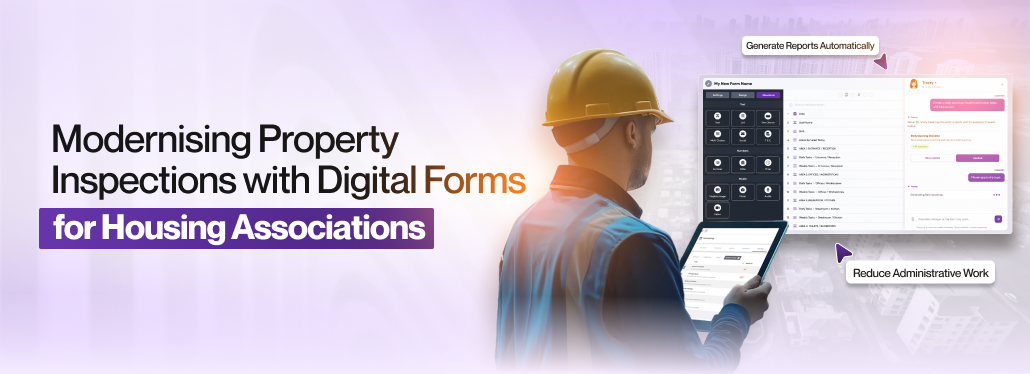
🔶 Generate Reports Automatically
Smart forms can generate structured reports that contain all relevant data in a single view. This speeds up communication, allows faster decision-making, and removes the delays associated with manual reporting.
🔶 Improve Compliance and Audit Readiness
Records are stored digitally with proper timestamps and supporting evidence. This makes it easy to retrieve information when required. Whether you are preparing an internal review or regulatory audit, housing associations can access organised and audit-ready documents without relying on paper files and disconnected systems.
🔶 Give Managers Real-Time Visibility
Live dashboards show what’s been inspected, what’s flagged, and what’s outstanding across every site, without waiting for someone to report back manually.
How AI Is Making Property Inspection Forms Even Smarter
Digital forms have eliminated the need for paperwork during property inspections. AI is now simplifying time-consuming tasks by creating the forms itself.
With Tracey AI, Tapapp’s AI-powered form builder, housing associations no longer have to manually recreate existing paper inspection forms. What can be done is simply upload a paper checklist or describe the property type inspection you need, and Tracey will automatically build it into a ready-to-use digital form within minutes.
This reduces the time and effort to digitise inspection processes. Whether it’s a routine property inspection, health and safety assessment, estate inspection, or maintenance checklist, teams can create consistent digital forms with minimal setup.
By combining AI-powered form creation with mobile data capture, one can roll out a new inspection workflow faster and spend time improving property operations instead of building forms from scratch.
How Tapapp Simplifies Property Inspections for Housing Associations
Housing inspections cannot be carried out in isolation; they need to stay connected to maintenance, compliance, etc. Tapapp brings everything under one system, helping housing associations streamline workflows from scheduling to reporting.
Using Tapapp’s Smart Forms, staff can complete property inspections from a mobile device, which is available to managers in real-time, reducing reporting delays.
Beyond inspections, Tapapp helps housing associations schedule recurring property visits, manage attendance, track completed work, and maintain a complete digital audit trail.
For businesses looking to digitise existing paper checklists, Tracey can convert paper inspection forms or simple text prompts to ready-to-use forms in minutes.
By bringing inspections, digital forms, automated reporting, and AI form creation into a single platform, Tapapp helps housing associations improve efficiency and strengthen accountability.
Frequently Asked Questions
Yes. Tapapp’s Smart Forms can be customised to suit different inspection needs, whether you are inspecting residential properties, void properties, communal areas, or carrying out health, safety, and compliance checks. Each form can be tailored to match your existing workflows.
Yes. Housing officers can complete inspections in areas with poor or no connectivity. Once the device reconnects, everything syncs automatically. No inspection has to wait for a signal.
Yes, inspection records sit in one centralised system, so housing officers and managers can all view relevant records from their own devices, based on what they have permission to see.
A flagged issue can move straight into maintenance scheduling, so there’s no delay between spotting a problem on-site and getting it assigned for action.
Minimum. Tapapp is designed to be easy to use, allowing housing teams to adopt digital inspections easily. Existing inspection forms and workflows can also be digitised, allowing staff to transition without changing how they already work.
Yes. Tapapp can seamlessly integrate with your existing business systems to support smoother data sharing. Integration needs vary depending on your existing software and workflow.